
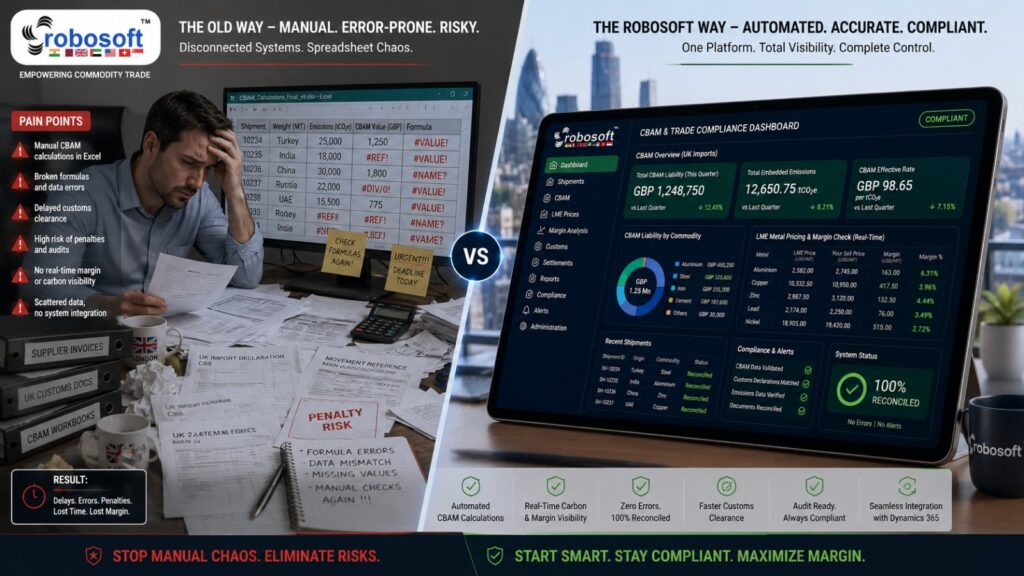
Managing modern Commodity trading UK operations requires specialized architecture to handle strict border taxes, volatile pricing, and tight liquidity. London commercial desks trade high volumes of metals, energy, and agricultural goods across global shipping corridors. However, trading houses face complex UK Carbon Border Adjustment Mechanism (UK CBAM) reporting, UK ETS compliance, and fast-moving London Metal Exchange (LME) margin calls. In addition, manual spreadsheets cannot calculate embedded carbon liabilities and multi-currency financing lines in real time. Therefore, trading companies implement integrated enterprise software to automate operations. Consequently, commercial desks eliminate customs delays, prevent costly tax fines, and protect net operating margins.
The New Operational Pressures on London and UK Trading Desks
The UK commodity market is undergoing rapid regulatory and structural changes. Traders operating out of London must manage strict customs rules, changing import tariffs, and demanding environmental disclosures.
Consequently, physical trading houses face serious administrative friction across daily operations. When commercial desks rely on legacy tools or disconnected spreadsheets, three major operational bottlenecks emerge:
- Carbon Duty Calculation Errors: Manual tracking of embedded carbon emissions leads to incorrect HMRC tax declarations and unexpected import surcharges.
- Delayed LME Margin Calls: Disconnected trading files fail to forecast intraday variation margin calls during sudden price swings.
- Fragmented Accounting Ledgers: Re-entering trade tickets into standalone accounting systems creates data duplication and reconciliation backlogs.
Eliminating Carbon Compliance Friction: UK CBAM and UK ETS
Physical commodity imports into the United Kingdom require strict accounting for direct and indirect greenhouse gas emissions.
First, commercial desks importing steel, aluminum, fertilizer, or hydrogen must capture verified supplier carbon assay data. Next, the trading system calculates the carbon price differential between the country of origin and the UK Emissions Trading Scheme (UK ETS). Finally, the software generates audit-ready HMRC compliance filings before cargo reaches UK customs borders.
Because spreadsheet models cannot link live carbon certificate prices with physical cargo weights, traders risk severe non-compliance penalties. Therefore, trading organizations require automated software engines to calculate accurate carbon costs before confirming purchase contracts.
How Robosoft Eliminates Trade and Tax Bottlenecks
- Traders spend hours in spreadsheets estimating UK CBAM duties per shipment.
- Errors in supplier emissions data trigger customs holds and costly port demurrage.
- Automated calculation of embedded carbon ($/MT) tied directly to deal tickets.
- Real-time sync with UK ETS benchmark allowances and live FX currency rates.
- Direct integration with Microsoft Dynamics 365 updates tax accruals instantly.
- Zero customs delays, 100% audit-ready HMRC reports, and protected trading profits.
Why Commodity Trading UK Firms Choose Robosoft Cloud CTRM
Commercial houses engaged in Commodity trading UK operations require an enterprise platform that removes operational bottlenecks and reduces manual workload.
Direct Operational Benefits for Trading Teams
Robosoft provides a purpose-built CTRM platform that directly solves core trading pain points:
- Eliminates Double Data Entry: Front-office deal bookings flow straight into middle-office risk and back-office accounting without manual re-typing.
- Automates UK Customs and VAT Rules: The system identifies freeport movements, domestic supplies, and cross-border duties automatically.
- Delivers Live Cash Flow Visibility: Treasury teams monitor bank borrowing facilities, Letter of Credit limits, and currency positions in one place.
Furthermore, running natively inside Microsoft Dynamics 365 ensures your corporate accounting stays fully synchronized with physical trading operations.
Real-Time LME Execution, Warrant Financing, and Margin Control
London is the global center for base metals trading. Physical metal merchants trade copper, aluminum, nickel, and zinc while actively hedging on the London Metal Exchange (LME).
The system evaluates the net delivered profit margin using dynamic commercial formulas:
Net UK Delivered Margin = Sale Realization – (LME Cash Price ± Physical Brand Premium + Freight + Storage Rent + UK CBAM Duty) ± Hedge PnL
Required Variation Margin = ∑ (Open Lot Size × (Current Settlement Price – Trade Entry Price))
When LME market volatility surges, clearing brokers issue immediate variation margin calls. Robosoft simulates price movements in real time to alert risk managers before margin thresholds are breached. As a result, commercial desks maintain sufficient cash reserves and protect trading lines.
Feature Comparison: Spreadsheets vs. Robosoft CTRM on Dynamics 365
Manual spreadsheets cannot match the speed, control, and compliance of an enterprise CTRM platform:
| Trading Requirement | Manual Spreadsheets | Robosoft CTRM Platform |
|---|---|---|
| UK CBAM Carbon Duty | Requires manual estimation and external calculator files. | Calculates embedded emissions and tax duties per contract automatically. |
| LME Warrant Management | Involves slow manual checks across depository registries. | Connects electronic warrant balances directly with financing ledgers. |
| Intraday Margin Tracking | Updates once a day after exchange settlement files arrive. | Calculates live variation margin alerts across all open derivatives. |
| Financial Audit Trail | Prone to overwritten formulas with no change logs. | Maintains complete, immutable audit trails for every deal edit. |
| ERP Architecture | Disconnected files requiring periodic copy-paste imports. | Runs natively on Microsoft Dynamics 365 Business Central and F&O. |
Official UK Directives and Statutory Compliance Standards
Commercial trading organizations operating in the United Kingdom must adhere to official legal, environmental, and financial guidelines.
Customs duty rules, import declarations, and UK CBAM tax directives must follow regulations governed by HM Revenue and Customs (HMRC).
In addition, industrial emissions compliance and carbon allowance trading follow standards established by the UK Environment Agency and UK ETS Authority.
Furthermore, physical metal warehouse warrants and contract settlement mechanisms comply with rules set by the London Metal Exchange (LME).
Frequently Asked Questions About Commodity Trading UK
1. What are the biggest operational challenges in UK commodity trading today?
UK trading desks face rising administrative workloads from UK CBAM carbon reporting, volatile LME margin requirements, and strict HMRC customs filing rules.
2. Why is dedicated software essential for Commodity trading UK operations?
Specialized systems for Commodity trading UK desks automate carbon duty calculations, manage bank credit lines, and link trade entries directly to corporate accounting ledgers.
3. How does Robosoft automate UK CBAM carbon duty calculations?
The platform matches supplier emissions certificates with cargo weights and current UK ETS market prices. Consequently, finance teams calculate exact carbon border liabilities before goods arrive at UK ports.
4. Can the system forecast LME margin calls in real time?
Yes. The software simulates intraday market price movements across all open metal futures and options. Therefore, treasury teams receive early warning alerts before broker margin calls hit cash accounts.
5. How does Robosoft integrate with Microsoft Dynamics 365?
Robosoft runs directly inside Microsoft Dynamics 365 tables. As a result, physical trade contracts, customs duties, and financial balance sheets update simultaneously with zero data delay.
6. What commodity sectors are supported for UK trading houses?
The platform supports base metals, precious metals, refined oil products, natural gas, biofuels, grains, oilseeds, and soft commodities.
Next Steps for UK Commercial Desks
Eliminating customs friction, automating carbon border taxes, and managing exchange price risk requires a purpose-built commodity trading platform.
- Discover how our Robosoft physical metal CTRM platform automates LME warrant tracking on Microsoft Dynamics 365.
- Explore our comprehensive Microsoft Dynamics 365 commodity ERP to eliminate disconnected business modules.
- Learn how our specialized energy trading and risk management software handles cross-border hydrocarbon flows.
- Contact our UK commodity technology team through our Robosoft Contact Page to schedule a live product demonstration.