Managing modern Commodity trading switzerland operations requires specialized architecture to handle global trade flows. Swiss trading hubs in Geneva, Zug, and Lugano finance a vast share of global energy, metals, and agricultural goods. However, merchant houses face complex transit trade structures, multi-currency credit lines, and evolving international trade sanctions. In addition, manual spreadsheets cannot calculate multi-bank borrowing bases and mark-to-market positions in real time. Therefore, Swiss trading houses implement integrated enterprise platforms to automate deal lifecycles. Consequently, commercial desks protect operational liquidity, ensure regulatory compliance, and eliminate settlement delays.
The Architecture of Swiss Transit Trade and Merchanting
Swiss merchant houses operate primarily through offshore transit trade, also known as merchanting trade (Transithandel). In these transactions, commodities move directly from international supplier ports to destination markets without entering Swiss customs territory.
Consequently, trading desks must coordinate freight logistics, customs paperwork, and bank payments across multiple time zones simultaneously. When operations teams rely on disconnected legacy workbooks, critical operational friction occurs:
- Mismatched Cargo Tracking: Disconnected shipping updates delay title transfers and vessel discharge clearances.
- Foreign Exchange Exposure: Cross-currency settlements in USD, EUR, CHF, and GBP cause unexpected treasury losses.
- Delayed Margin Calculations: Back-office accounting teams struggle to reconcile provisional invoices against final assay adjustments.
Managing Multi-Bank Borrowing Bases and Collateral Headroom
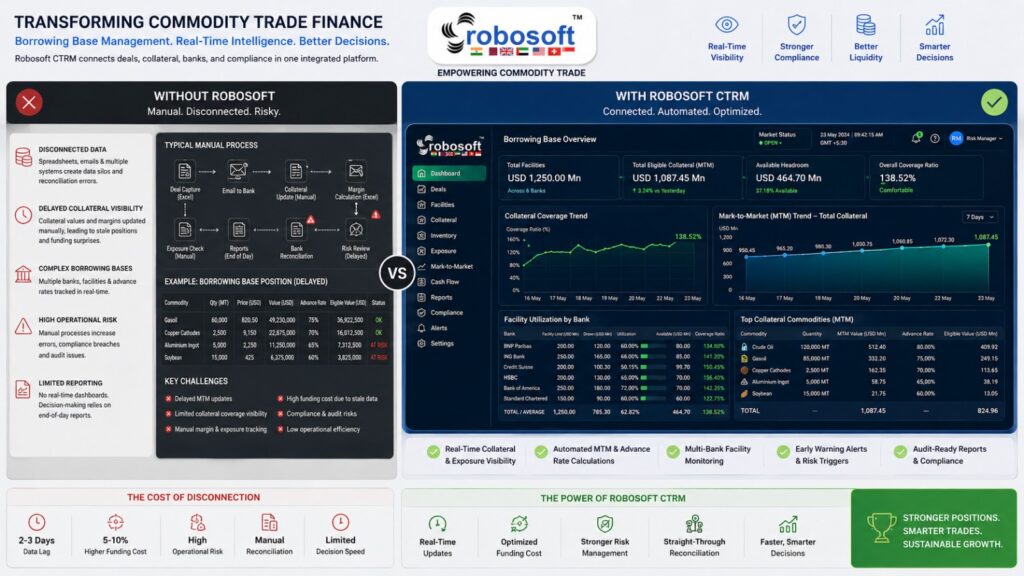
Merchant houses in Geneva and Zug rely heavily on syndicated and bilateral Borrowing Base Facilities (BBF) to fund high-value physical shipments.
First, commercial desks pledge physical inventories, transit bills of lading, and eligible receivables to partner banks. Next, financing institutions assign advance rates based on commodity liquidity and transit status. Finally, credit facilities release liquidity for physical purchases while monitoring collateral values continuously.
Because market prices fluctuate every second, unmonitored portfolios risk sudden collateral deficits. Therefore, finance teams require real-time systems to track borrowing base availability across active trade finance banks.
Transit Trade Collateral and Credit Execution Workflow
- Trade: 60,000 MT Gasoil FOB Middle East to Northwest Europe
- Documentation: Electronic Bill of Lading & Commercial Invoice Ingested
- Automated 85% Advance Rate Applied against Real-Time Benchmark Curves
- Multi-Currency Facility Drawdown Reconciled across Swiss Banking Syndicate
- Live Derivative Hedging Connected on ICE / CME Exchanges
- Payment Collected via Bank LC | Loan Line Restored with Zero Latency
Why Commodity Trading Switzerland Enterprises Require Cloud CTRM
International commercial firms engaged in Commodity trading switzerland must balance extreme volatility with tight banking covenants.
Enterprise Architecture Capabilities
A specialized platform for Commodity trading switzerland desks delivers vital operational advantages:
- Syndicated Loan Management: The software monitors credit allocations, interest accruals, and collateral ratios across multiple banking partners.
- Automated FX Exposure Hedging: It calculates net foreign exchange exposures across physical and derivative books in real time.
- Real-Time Transit Accounting: It reconciles freight demurrage, vessel charter costs, and inspection fees directly into general ledger accounts.
Furthermore, deploying an integrated CTRM engine eliminates data duplication between risk managers in Geneva and operations teams globally.
Automating Multi-Jurisdiction Compliance and Sanctions Screening
Swiss trading entities operate under comprehensive national and international trade compliance mandates.
The platform evaluates the net transit margin using dynamic trade formulas:
Net Transit Margin = Sales Price – (Procurement Cost + Ocean Freight + Insurance + Port Fees + Financing Charges) ± Hedge PnL
Borrowing Base Availability = ∑ (Eligible Cargo Value × Advance Rate) – Outstanding Credit Drawdowns
Desks must verify counterparties, vessel ownership histories, and cargo origin certificates before trade confirmation. Modern systems integrate automated compliance screening against State Secretariat for Economic Affairs (SECO), European Union, and OFAC lists. As a result, commercial trading houses maintain clean audit trails and prevent regulatory violations.
Feature Comparison: Legacy Systems vs. Modern Swiss CTRM
Generic enterprise software packages fail to support the specialized financing and transit trade workflows used across Switzerland:
| Operational Requirement | Legacy ERP / Spreadsheets | Specialized Swiss CTRM (Robosoft) |
|---|---|---|
| Borrowing Base Monitoring | Requires manual spreadsheet updates once per week. | Calculates dynamic borrowing base headroom in real time. |
| Transit Trade Accounting | Treats offshore trade as domestic stock transactions. | Separates merchanting transactions under Swiss tax rules. |
| Automated Sanctions Checks | Relies on slow manual searches across external websites. | Screens counterparties and vessels via direct API feeds. |
| Multi-Currency Revaluation | Calculates currency variance retrospectively at month-end. | Executes real-time FX revaluations across all active books. |
| Microsoft Dynamics 365 Core | Operates as an unverified external data sheet. | Runs natively inside Dynamics 365 Business Central and F&O. |
Swiss Statutory Directives and Global Regulatory Frameworks
Commercial trading houses operating within Switzerland must comply with established legal and financial standards.
Trade sanctions monitoring and international trade controls must follow statutory rules established by the Swiss State Secretariat for Economic Affairs (SECO).
In addition, Swiss commercial book-keeping and transit trade reporting follow accounting governance under the Swiss Code of Obligations (Fedlex Swiss Federal Law).
Furthermore, derivative risk governance and market conduct guidelines align with standards established by the Swiss Financial Market Supervisory Authority (FINMA).
Frequently Asked Questions About Commodity Trading Switzerland
1. Why is Switzerland a leading global hub for commodity trading?
Switzerland provides access to specialized commodity trade finance banks, stable legal frameworks, experienced maritime logistics providers, and deep international talent pools.
2. Why is specialized software essential for Commodity trading switzerland desks?
Dedicated platforms for Commodity trading switzerland automate multi-currency credit line tracking and transit trade accounting. Therefore, finance teams manage complex borrowing base facilities with complete accuracy.
3. How does the system automate borrowing base calculations?
The platform updates collateral values continuously as underlying market prices shift. Consequently, treasury teams prevent margin breaches and optimize liquidity allocations across lending syndicates.
4. Can the software handle automated sanctions screening?
Yes. The platform screens counterparties, ultimate beneficial owners, and vessel IMO numbers against international sanctions lists before deal approval.
5. How does Robosoft connect with Microsoft Dynamics 365?
Robosoft operates natively inside Microsoft Dynamics 365 data structures. As a result, physical trade contracts, banking fees, and general ledger accounts update simultaneously with zero latency.
6. What commodities are supported across Swiss trading operations?
The platform supports crude oil, refined petroleum products, natural gas, LNG, base metals, precious metals, grains, and soft commodities.
Next Steps for Swiss Trading Desks
Automating transit trade finance, multi-currency risk management, and regulatory compliance requires an enterprise commodity trading platform.
- Discover how our unified Microsoft Dynamics 365 commodity ERP eliminates disconnected business modules.
- Explore our specialized energy trading and risk management suite for comprehensive portfolio control.
- Learn more about our Robosoft physical metal CTRM platform to manage global metal warrant flows.
- Contact our Swiss commodity technology specialists through our Robosoft Contact Page to schedule a live product demonstration.