
By Marcus Vance, Principal Agri Solutions Architect at Robosoft
Reviewed by Neil Thornton, Head of CTRM Architecture
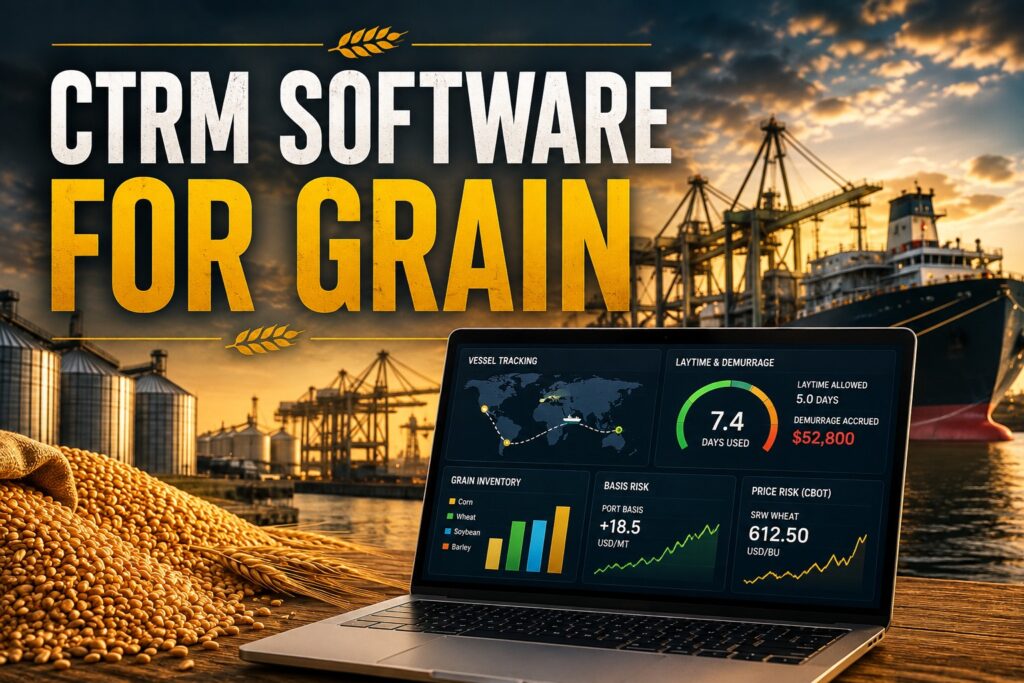
Deploying dedicated CTRM software for grain has become crucial for international agricultural trading houses. Global grain desks face persistent maritime bottlenecks, changing export tariffs, and shifting basis spreads. In addition, manual spreadsheets cannot calculate fluctuating vessel demurrage and freight costs in real time. Therefore, trading firms need specialized systems to protect operating margins and settle physical bulk contracts without delays.
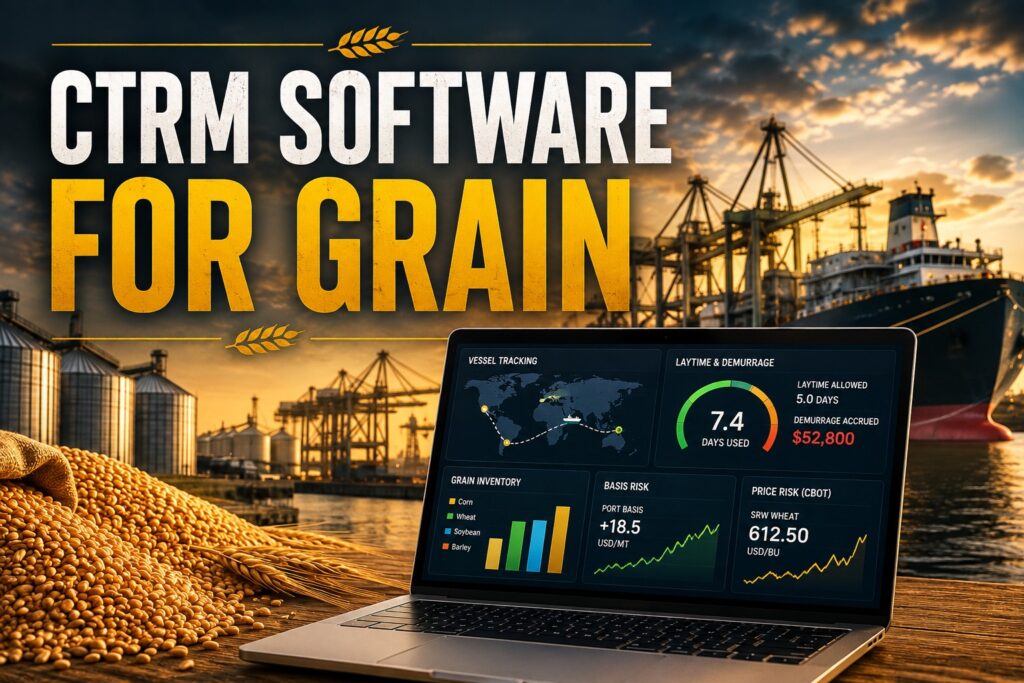
Table of Contents
- Global Grain Disruptions and Logistics Bottlenecks
- Managing Vessel Chartering, Laytime, and Demurrage
- Why Dedicated CTRM Software for Grain Is Crucial
- Navigating Basis Risk and Futures Price Spreads
- Feature Comparison: Specialized Agri CTRM vs. Generic ERP
- Regional Execution Across Global Trading Hubs
- Statutory Directives and International Grain Rules
- Frequently Asked Questions About CTRM Software for Grain
- Next Steps for Agricultural Desks
Global Grain Disruptions and Logistics Bottlenecks
Physical grain supply chains face continuous geopolitical and climatic shocks. Export restrictions, canal transit limits, and unexpected weather events force trading desks to re-route bulk shipments regularly.
Consequently, agricultural traders manage high freight volatility alongside physical commodity price swings. When operations teams rely on disconnected tools, critical problems occur:
- Silo and Port Congestion: Loading delays at origin terminals lead to expensive vessel wait times.
- Unplanned Route Changes: Diverting a Panamax cargo of wheat or corn alters delivered freight parity instantly.
- Quality Deterioration: In-transit moisture spikes cause grading penalties at the destination discharge port.
Managing Vessel Chartering, Laytime, and Demurrage
Bulk grain trade profitability depends heavily on maritime freight execution. However, traditional accounting systems cannot track complex charter party contract terms.
First, operations teams must monitor laytime allowances across loading and discharge ports. If cargo operations exceed agreed laytime, the shipowner charges heavy daily demurrage fees.
In contrast, completing cargo transfers early earns dispatch savings. Because generic ERPs cannot automate laytime statements, finance teams calculate demurrage claims manually. Therefore, disputed freight invoices linger for months and reduce trade cash flow.
+-----------------------------------------------------------------------------------+
|                        PHYSICAL GRAIN TRADE CAPTURE                               |
|  • Commodity: 60,000 MT Milling Wheat (Panamax Bulk Vessel)                       |
|  • Pricing: CBOT Soft Red Winter Wheat Futures + Port Basis Premium               |
|  • Laytime Allowed: 5 Weather Working Days (WWD) | Demurrage Rate: $22,000/day     |
+-----------------------------------------------------------------------------------+
                                         |
                                         v
+-----------------------------------------------------------------------------------+
|                     AUTOMATED VESSEL & LAYTIME TRACKING                           |
|  • Notice of Readiness (NOR) Tendered & Verified                                  |
|  • Statement of Facts (SOF) Ingested: Rain Delays & Berth Congestion Deducted      |
|  • Net Laytime Consumed: 7.4 Days -> Demurrage Liability: $52,800 Real-Time Accrual|
+-----------------------------------------------------------------------------------+
                                         |
                                         v
+-----------------------------------------------------------------------------------+
|               FINAL VOYAGE SETTLEMENT & PROFIT CAPTURE                            |
|  • Washout Settled | Freight Adjusted | Real-Time Net Trading Margin Realized     |
+-----------------------------------------------------------------------------------+
Why Dedicated CTRM Software for Grain Is Crucial
Agricultural trading firms implement specialized CTRM software for grain to unify physical contracts, vessel chartering, and derivative risk.
A modern CTRM software for grain platform automates operational workflows:
- Real-Time Laytime Statements: The software reconciles Statement of Facts (SOF) logs to calculate demurrage and dispatch liabilities automatically.
- Vessel Chartering Management: It links time-charter and voyage-charter contracts directly to underlying physical purchase and sale commitments.
- Dynamic Mark-to-Market: It revalues open grain contracts continuously against live Chicago Board of Trade (CBOT) and Euronext (MATIF) pricing curves.
Furthermore, an integrated CTRM software for grain system tracks grain quality parameters, including moisture, protein, foreign matter, and falling numbers.
Navigating Basis Risk and Futures Price Spreads
Physical grain trading rarely relies on flat pricing alone. Instead, physical transactions price using a floating exchange benchmark combined with a local cash basis:
$$\text{Delivered Physical Price} = (\text{Futures Benchmark Price} \pm \text{Local Cash Basis}) + \text{Ocean Freight} + \text{Demurrage Accrual}$$
Local cash basis reflects regional supply shortages, elevation costs, and port handling fees. When the local cash basis widens unexpectedly, an unhedged trading desk faces severe margin erosion even if the exchange futures hedge is profitable.
Specialized agricultural software tracks basis exposure independently from outright price risk. As a result, risk managers maintain clear visibility over both exchange movements and regional cash differentials.
Feature Comparison: Specialized Agri CTRM vs. Generic ERP
Standard corporate ERP systems fail to support the dynamic nature of physical grain logistics:
| Trading Capability | Generic Corporate ERP | Specialized Grain CTRM (Robosoft) |
| Laytime & Demurrage | Requires manual spreadsheet reconciliations and journal entries. | Automates SOF ingestion, rain delay deductions, and demurrage calculations. |
| Basis Trading Mechanics | Manages flat unit costs without basis pricing visibility. | Isolates futures prices and local cash basis for accurate hedge management. |
| Quality Grade Adjustments | Treats agricultural stock as fixed inventory SKUs. | Applies automated discount and premium matrices for protein and moisture. |
| String Trade Settlements | Cannot link physical circles, washouts, and book-outs. | Automates multi-party contract circle identification and net invoicing. |
| Microsoft Dynamics 365 Core | Relies on custom third-party middleware connectors. | Operates directly on native Business Central and F&O data tables. |
Regional Execution Across Global Trading Hubs
Physical grain trading desks operate across major international commercial centers:
- Singapore (APAC Trading Hub): Regional desks manage Australian and Southeast Asian grain flows, utilizing automated tools to track regional transshipment and financing credit lines.
- United Arab Emirates (Dubai / DMCC): Middle Eastern trading companies source bulk wheat and barley for regional food security programs, managing port logistics in Fujairah and Jebel Ali.
- India (Domestic and Export Markets): Desks coordinate domestic mandi procurement, state taxes, and warehousing with international export standards and freight commitments.
- United Kingdom and Europe: European grain desks manage cross-border wheat and oilseed flows, tracking Euronext exchange hedges alongside strict import sustainability mandates.
- Qatar and Middle East Desks: Importers manage bulk grain supply tenders, long-term procurement agreements, and strategic silo storage reserves.
Statutory Directives and International Grain Rules
Physical agricultural trades must adhere to established international trade contracts and arbitration frameworks.
Most global grain and oilseed contracts trade under standardized contract rules governed by the Grain and Feed Trade Association (GAFTA) Contract Framework.
In addition, maritime bulk shipments and vessel chartering terms follow standardized documentation published by the BIMCO Maritime Chartering Standards.
Frequently Asked Questions About CTRM Software for Grain
1. What is the primary function of CTRM software for grain?
CTRM software for grain automates physical trade capture, vessel chartering logistics, basis risk management, and settlement accounting for agricultural trading houses.
2. Why is specialized CTRM software for grain necessary for demurrage tracking?
A dedicated CTRM software for grain system tracks Statement of Facts logs and port delays automatically. Therefore, trading desks calculate exact demurrage liabilities without manual calculation errors.
3. How does the software handle quality grade discounts and premiums?
The platform uses automated deduction matrices. Consequently, when lab inspection reports reveal high moisture or low protein, the system adjusts final settlement invoices instantly.
4. Can the platform manage physical string trades and washouts?
Yes. The software identifies contract circles between counterparties, allowing traders to execute cash settlement washouts without unnecessary physical cargo handling.
5. How does Robosoft integrate with Microsoft Dynamics 365?
Robosoft runs natively on Microsoft Dynamics 365 tables. As a result, physical trade bookings, vessel logistics costs, and general ledger accounts synchronize simultaneously without data lag.
6. Does the software support multi-currency trade financing?
Yes. The system manages foreign exchange exposure, trade loans, and letters of credit directly against physical cargo commitments.
Next Steps for Agricultural Desks
Managing physical grain logistics, vessel laytime calculations, and complex basis risk requires a purpose-built commodity trading engine.
- Discover how our agro CTRM software for grain traders automates bulk agricultural trade lifecycles on Microsoft Dynamics 365.
- Explore our integrated commodity trading chartering software capabilities for comprehensive maritime logistics management.
- Speak directly with our industry specialists through our Robosoft Contact Page to schedule a live product demonstration.