
By Aakash Verma, Principal CTRM Solutions Architect at Robosoft
Reviewed by Neil Thornton, Head of CTRM Architecture
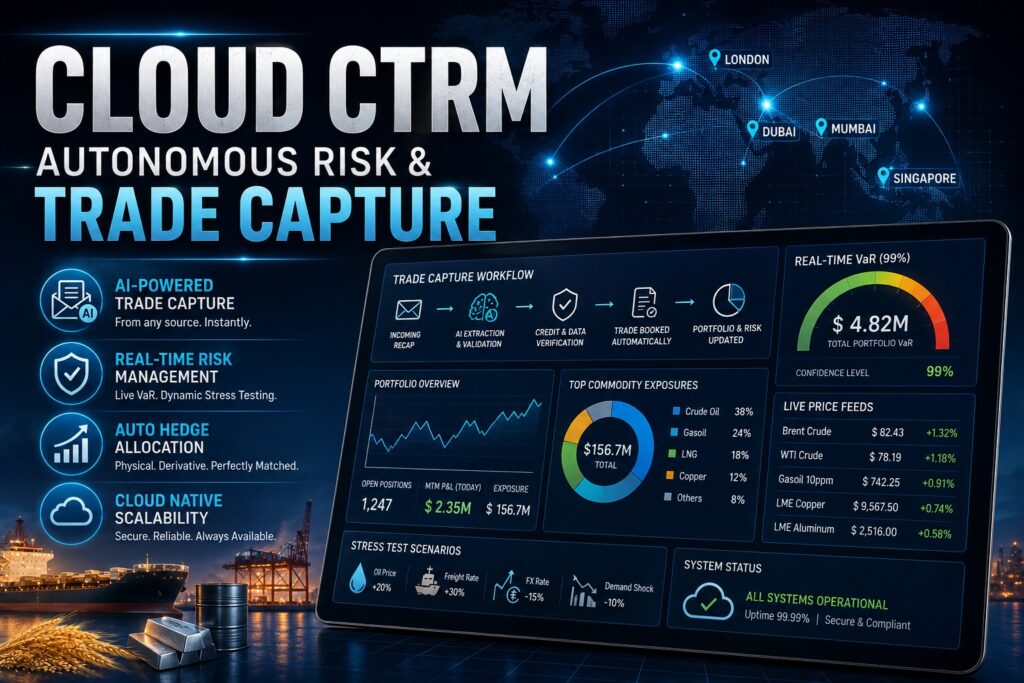
Deploying a modern Cloud CTRM platform has become vital for enterprise commodity trading desks. Physical commodity trading desks handle thousands of trade confirmations, broker recaps, and freight invoices every week. However, manual data entry slows trade execution and causes expensive settlement discrepancies. Therefore, forward-thinking trading houses use artificial intelligence to automate trade capture and calculate real-time market risk. Consequently, commercial desks can eliminate trade processing bottlenecks and protect trading margins.
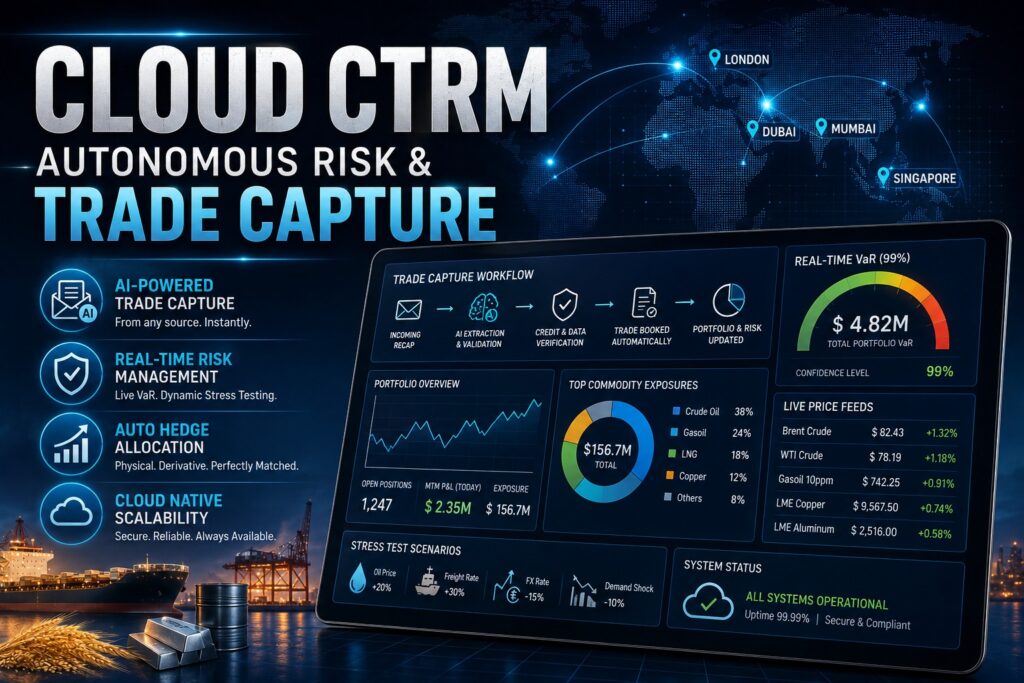
Table of Contents
- The High Cost of Manual Trade Ingestion
- How Machine Learning Automates Trade Confirmation Ingestion
- Why Modern Cloud CTRM Platforms Drive Operational Efficiency
- Real-Time Value at Risk (VaR) and Dynamic Stress Testing
- Feature Comparison: Legacy On-Premise CTRM vs. AI-Powered Cloud CTRM
- Regional Trade Desks: Singapore, Dubai, London, and Mumbai
- Statutory Directives and Algorithmic Trading Standards
- Frequently Asked Questions About Cloud CTRM
- Next Steps for Enterprise Trading Desks
The High Cost of Manual Trade Ingestion
Physical commodity transactions involve unstructured data formats across emails, PDFs, and messaging channels. For example, instant messages and broker recaps contain variable pricing terms, laycan windows, and delivery tolerances.
When risk teams retype these terms into disconnected systems, multiple operational risks arise:
- Trade Capture Lag: Manual booking creates multi-hour delays between trade execution and risk reporting.
- Pricing Formula Errors: Operators misinterpret complex index formulas, leading to incorrect invoice generation.
- Incomplete Position Visibility: Traders commit to new physical deals without seeing real-time net portfolio exposure.
How Machine Learning Automates Trade Confirmation Ingestion
Modern artificial intelligence transforms unstructured trade recaps into validated trade records within seconds.
First, Large Language Models (LLMs) and natural language processing extract core trade parameters from incoming emails.
Next, the extraction engine identifies counterparties, quantity tolerances, delivery windows, and pricing benchmark curves.
Finally, the system reconciles the extracted details against master counterparty records and credit limits. If all checks pass, the trade books automatically into the trade ledger.
+-----------------------------------------------------------------------------------+
|                        UNSTRUCTURED TRADE RECAP INGESTION                         |
|  • Inbound Source: Broker Email / PDF Confirmation / Instant Message              |
|  • Unstructured Data: 5,000 MT Gasoil 10ppm | FOB Singapore | Mean Platts + $2.10 |
+-----------------------------------------------------------------------------------+
                                         |
                                         v
+-----------------------------------------------------------------------------------+
|                     MACHINE LEARNING EXTRACTION & VALIDATION                      |
|  • Entity Parsing: Counterparty KYC Verified | Credit Line Tolerance Checked      |
|  • Benchmark Mapping: Pricing Formula Connected to Live Platts Curve              |
|  • Straight-Through Processing (STP) Trade Ticket Created Instantly               |
+-----------------------------------------------------------------------------------+
                                         |
                                         v
+-----------------------------------------------------------------------------------+
|               CONSOLIDATED REAL-TIME POSITION & VaR RECALCULATION                 |
|  • Instant Mark-to-Market Valuation | Automated Hedge Allocation Triggered        |
+-----------------------------------------------------------------------------------+
Why Modern Cloud CTRM Platforms Drive Operational Efficiency
Enterprise trading desks require scalable infrastructure to process large transaction volumes. For this reason, trading companies transition to an integrated Cloud CTRM architecture to support straight-through processing.
- Automated Data Normalization: An advanced Cloud CTRM converts multi-source trade confirmations into standardized database records automatically.
- Real-Time Hedge Matching: It connects physical purchase commitments with matching derivative hedges on ICE, CME, or SGX.
- Continuous Portfolio Valuation: It recalculates open positions whenever underlying benchmark prices fluctuate.
As a result, operations teams reduce administrative overhead and accelerate physical trade settlements.
Real-Time Value at Risk (VaR) and Dynamic Stress Testing
Traditional risk systems run overnight batch calculations to determine market exposure. However, overnight calculations fail to protect desks during extreme intraday price swings.
Modern risk platforms calculate Parametric and Monte Carlo Value at Risk (VaR) continuously:
$$\text{VaR}_{\alpha} = \mu_{\text{Portfolio}} + \sigma_{\text{Portfolio}} \times Z_{\alpha} \times \sqrt{\Delta t}$$
- In this formula, $\mu_{\text{Portfolio}}$ represents the expected portfolio return over the holding period $\Delta t$.
- The term $\sigma_{\text{Portfolio}}$ represents the volatility matrix across all open physical and derivative contracts.
- $Z_{\alpha}$ reflects the confidence interval factor (for example, 99% or 95% confidence).
In addition, the risk engine simulates extreme geopolitical disruptions and pipeline outages. Therefore, chief risk officers can evaluate potential portfolio drawdowns before entering volatile market sessions.
Feature Comparison: Legacy On-Premise CTRM vs. AI-Powered Cloud CTRM
The technical differences between legacy platforms and modern cloud architectures impact daily trading performance:
| Operational Capability | Legacy On-Premise CTRM | AI-Powered Cloud CTRM (Robosoft) |
| Trade Ingestion | Requires manual keyboard entry from paper confirmations. | Extracts parameters from PDFs and emails using machine learning. |
| Risk Recalculation | Runs slow overnight batch jobs for portfolio VaR. | Recalculates intraday VaR and Greeks continuously. |
| Scalability & Uptime | Requires dedicated internal server maintenance. | Scales dynamically on secure enterprise cloud infrastructure. |
| Hedge Allocation | Involves manual linking of physical lots to futures contracts. | Automates derivative hedge allocation via smart matching logic. |
| ERP Integration | Relies on custom, error-prone batch sync scripts. | Operates natively inside Microsoft Dynamics 365 tables. |
Regional Trade Desks: Singapore, Dubai, London, and Mumbai
Global commodity trading hubs require rapid trade capture and local regulatory compliance:
- Singapore (APAC Regional Hub): Trading houses in Jurong use automated ingestion to manage high-frequency bunker and palm oil contracts.
- United Arab Emirates (Dubai / DMCC): Desks managing energy and bullion transactions use real-time risk controls to monitor multi-currency credit lines.
- United Kingdom (London Desks): London energy and metals desks implement algorithmic hedging to manage tight LME and ICE price spreads.
- India (Domestic and Cross-Border Desks): Firms coordinate domestic mandi purchases and MCX hedges with international supply contracts.
- Qatar and Middle East Desks: Gas and petrochemical producers automate long-term contract pricing formulas against volatile spot markets.
Statutory Directives and Algorithmic Trading Standards
Automated trade execution and risk management workflows must comply with established financial market guidelines.
Desks trading international energy and commodity derivatives must maintain audit-ready trade capture logs under the Commodity Futures Trading Commission (CFTC) Risk Management Rules.
Furthermore, international financial institutions and trading entities follow capital adequacy and market risk principles established by the Bank for International Settlements (BIS) Basel Framework.
Frequently Asked Questions About Cloud CTRM
1. What is a Cloud CTRM platform?
A Cloud CTRM platform is a cloud-native software solution that manages the complete lifecycle of physical and derivative commodity transactions, logistics, and risk controls.
2. How does artificial intelligence automate physical trade capture?
AI uses natural language processing to extract key commercial data from unstructured emails and PDFs. Therefore, trading desks create trade tickets without manual keyboard entry.
3. Why is real-time VaR calculation superior to overnight batch processing?
Intraday VaR updates continuously as exchange prices shift. Consequently, risk managers spot margin breaches immediately during volatile trading sessions.
4. Can the system match derivative hedges to physical contracts automatically?
Yes. The software links physical purchase commitments with matching futures contracts on exchanges like ICE, CME, or SGX based on pre-set hedging rules.
5. How does Robosoft integrate with Microsoft Dynamics 365?
Robosoft operates directly on native Microsoft Dynamics 365 data structures. As a result, trade bookings, inventory movements, and ledger postings synchronize with zero latency.
6. Is trade data secure in a cloud environment?
Yes. The architecture utilizes enterprise encryption, multi-factor authentication, and role-based access controls to safeguard proprietary trading records.
Next Steps for Enterprise Trading Desks
Automating trade capture, accelerating straight-through processing, and monitoring real-time portfolio risk requires a purpose-built commodity management platform.
- Explore our unified Microsoft Dynamics 365 commodity ERP to eliminate disconnected middleware.
- Learn how our specialized energy trading and risk management software automates complex deal workflows.
- Speak with our solution consultants through our Robosoft Contact Page to schedule a live product demonstration.