
By Marcus Vance, Principal Marine Solutions Architect at Robosoft
Reviewed by Neil Thornton, Head of CTRM Architecture
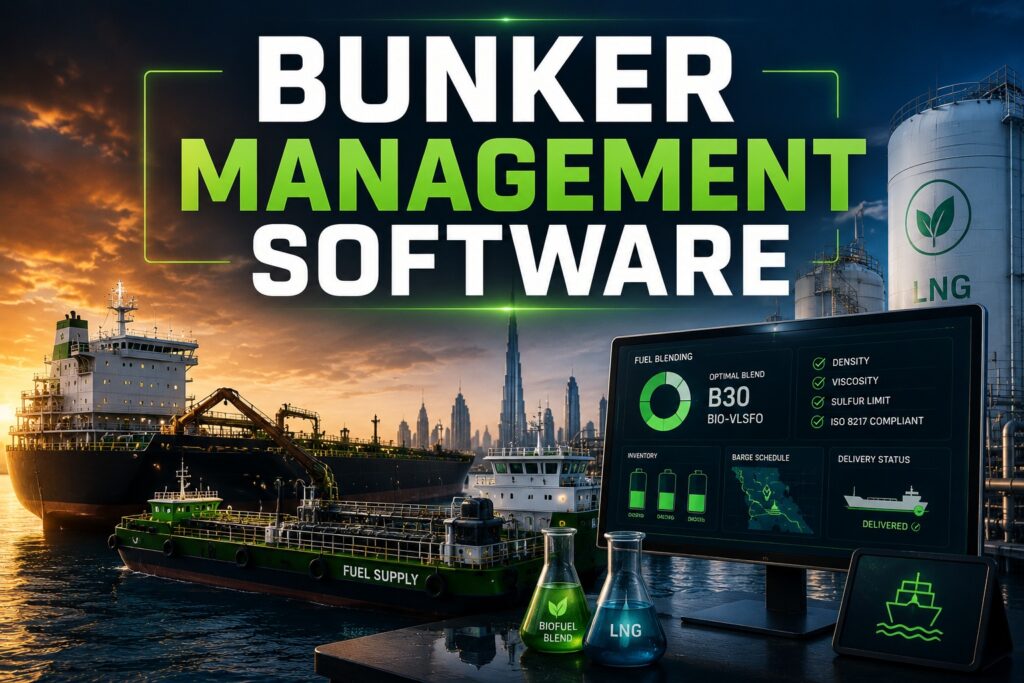
Deploying modern bunker management software is now crucial for physical marine fuel suppliers. Global maritime regulations require suppliers to handle complex multi-fuel blends like biofuels, LNG, and methanol. In addition, physical traders must manage tight fuel specifications and changing port rules. Therefore, automated systems help operators balance fuel quality, track barge logistics, and protect trading margins in real time. Consequently, marine fuel desks can prevent costly off-spec claims and settle invoices faster.
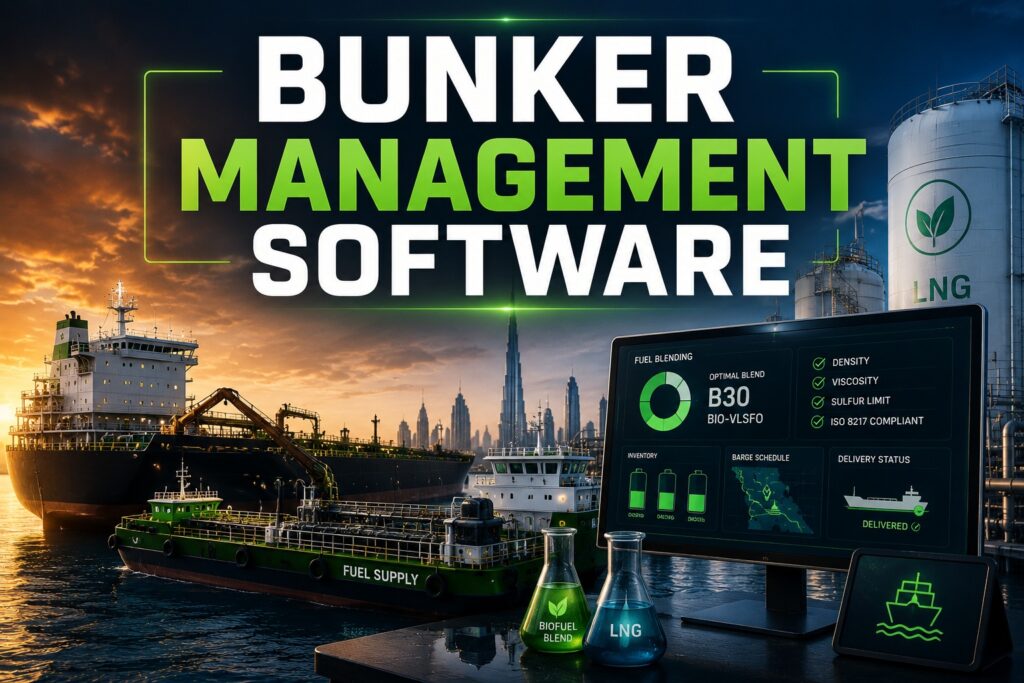
Table of Contents
- The Shift to Multi-Fuel Marine Operations
- Why Traditional Systems Fail in Bunker Blending
- Key Capabilities of Modern Bunker Management Software
- Automating Density and Viscosity Calculations
- Comparing Specialized Bunkering Systems with Standard ERPs
- Regional Port Workflows in Dubai, Singapore, and the UK
- Statutory Directives and Maritime Standards
- Frequently Asked Questions About Bunker Management Software
- Next Steps for Bunkering Desks
The Shift to Multi-Fuel Marine Operations
The bunkering sector is experiencing massive operational changes. Marine fuel suppliers no longer trade only standard Very Low Sulfur Fuel Oil (VLSFO) and Marine Gas Oil (MGO).
Instead, physical desks now supply B24 and B30 biofuel blends, bio-methanol, and liquefied natural gas. For this reason, bunkering teams must track multiple product grades across shore tanks and delivery barges.
Furthermore, every fuel grade features unique viscosity, flash point, and energy density requirements. As a result, fuel suppliers need connected operational tools to prevent compatibility issues during vessel delivery.
Why Traditional Systems Fail in Bunker Blending
Spreadsheets and basic enterprise systems cannot handle non-linear fuel blending recipes. When bunker desks manage operations manually, several critical issues occur:
- Off-Spec Density Risks: Combining different cutter stocks can cause fuel instability. Consequently, fuel batches fail ISO 8217 quality standards before delivery.
- Manual Barge Scheduling: Disconnected tools slow down barge dispatching. As a result, suppliers face heavy vessel demurrage charges at busy ports.
- Delayed Exposure Tracking: Spot fuel prices fluctuate continuously. Therefore, manual spreadsheets fail to provide accurate mark-to-market valuations for open purchase contracts.
Key Capabilities of Modern Bunker Management Software
Commodity trading desks require specialized tools to manage physical marine supply chains. For this reason, trading companies implement dedicated bunker management software to link physical inventory directly with back-office accounting.
- Automated Fuel Recipes: The system calculates optimal component ratios to meet target sulfur, density, and viscosity parameters at the lowest cost.
- Digital Bunker Delivery Notes: It generates verified electronic delivery documentation instantly to accelerate counterparty verification.
- Integrated Exposure Engines: It connects physical contracts with derivative paper hedges to protect operating margins.
+-----------------------------------------------------------------------------------+
|                        PHYSICAL BUNKER ORDER ENTRY                                |
|  • Order: 2,500 MT B30 Bio-VLSFO Stem                                             |
|  • Target Specs: Max 0.50% Sulfur | Min 60°C Flash Point | Target 380 cSt         |
+-----------------------------------------------------------------------------------+
                                         |
                                         v
+-----------------------------------------------------------------------------------+
|                     AUTOMATED LEAST-COST BLENDING ENGINE                          |
|  • Component A (70%): High-Sulfur Fuel Oil (HSFO) + Low-Sulfur Cutter Stock       |
|  • Component B (30%): Used Cooking Oil Methyl Ester (UCOME Bio-feedstock)         |
|  • Viscosity & Density Index Reconciliation Matrix Applied                        |
+-----------------------------------------------------------------------------------+
                                         |
                                         v
+-----------------------------------------------------------------------------------+
|               ELECTRONIC BUNKER DELIVERY NOTE (e-BDN) ISSUED                      |
|  • Real-Time Mass Flow Meter (MFM) Integration & Live MTM Profit Captured         |
+-----------------------------------------------------------------------------------+
Automating Density and Viscosity Calculations
A dedicated bunker management software solution eliminates manual calculation errors through automated blending formulas.
In physical fuel blending, viscosity does not mix linearly by volume. Therefore, the system utilizes the Refined Viscosity Blending Index (VBI) to calculate exact target outcomes:
$$\text{VBI}_i = \frac{\log_{10}(\log_{10}(\nu_i + 0.7))}{\log_{10}(10)}$$
$$\text{VBI}_{\text{Blend}} = \sum (x_i \times \text{VBI}_i)$$
- In these equations, $\nu_i$ represents the kinematic viscosity of each individual blend component in centistokes (cSt).
- The variable $x_i$ represents the mass fraction of that component in the overall mixture.
As a result, operations teams achieve exact compliance with contractual viscosity limits without wasting expensive cutter stocks.
Comparing Specialized Bunkering Systems with Standard ERPs
Standard corporate ERP platforms treat marine fuels as generic static products. In contrast, specialized commodity platforms handle complex maritime trading operations:
| Operational Capability | Standard ERP (e.g., SAP, Oracle) | Specialized Bunker ERP (Robosoft) |
| Non-Linear Blending | Uses simple linear averages that cause off-spec fuel blends. | Implements automated Viscosity Blending Index matrices. |
| Barge Logistics Tracking | Manages basic warehouse locations without vessel tracking. | Tracks barge pumping rates, laytime, and demurrage exposure. |
| Mass Flow Meter (MFM) Integration | Requires manual data input from paper delivery notes. | Connects directly with digital systems to capture flow meter data. |
| Alternative Fuel Accounting | Lacks sustainability and lifecycle emissions tracking. | Tracks Proof of Sustainability (PoS) data for marine biofuels. |
| Microsoft Dynamics 365 Core | Requires custom external API connectors. | Runs natively inside Dynamics 365 Business Central and F&O. |
Regional Port Workflows in Dubai, Singapore, and the UK
Physical marine fuel distribution depends on local port infrastructure and regional regulations:
- United Arab Emirates (Dubai / Fujairah Hub): Fujairah is one of the largest bunkering hubs in the world. Suppliers running a dedicated Bunkering ERP Dubai infrastructure track terminal throughput, offshore anchorage barge deliveries, and local VAT exemptions on high-seas transfers.
- Singapore (Jurong Port): Singapore leads global maritime digitalization. Traders use integrated systems to issue mandatory digital bunkering documentation directly to the Maritime and Port Authority.
- United Kingdom and Northern Europe: Desks operating with a Bunkering ERP UK setup track FuelEU Maritime compliance, Emissions Trading System allowances, and strict low-sulfur Emission Control Area (ECA) standards.
- Qatar and India: Emerging LNG and green fuel corridors require physical suppliers to integrate domestic taxation with international marine delivery contracts.
Statutory Directives and Maritime Standards
Physical bunker operations must strictly adhere to international maritime environmental standards.
Globally, all marine fuel deliveries must comply with the sulfur caps and emissions reporting rules set by the International Maritime Organization MARPOL Annex VI Directives.
In Singapore, suppliers must issue electronic bunker delivery notes in compliance with the digital bunkering frameworks established by the Maritime and Port Authority of Singapore Digital Bunkering Guidelines.
Frequently Asked Questions About Bunker Management Software
Bunker management software automates fuel trade capture, blending optimization, barge logistics, and trade risk management for physical marine fuel suppliers.
Dedicated bunker management software automates non-linear viscosity calculations and sulfur balancing. Therefore, suppliers avoid costly off-spec fuel disputes and optimize component costs.
The software captures mass flow meter delivery data electronically. Consequently, it generates tamper-proof digital delivery notes that comply with port authority regulations in Singapore and the UAE.
Yes. The system tracks sustainability certificates, feedstock origin details, and greenhouse gas reduction percentages alongside physical batch numbers.
The software connects with Commodity trading Risk management software to link physical bunker stems with forward swap contracts, giving traders a real-time view of net market exposure.
A native Dynamics 365 solution eliminates disconnected middleware. Therefore, trade tickets, barge inventory, and general ledger accounts update simultaneously with zero data lag.
Next Steps for Bunkering Desks
Managing alternative marine fuel blending, barge operations, and environmental compliance requires a purpose-built operational platform.
- Discover how our integrated bunker trading and blending ERP simplifies multi-fuel trade lifecycles on Microsoft Dynamics 365.
- Connect directly with our technical team through our Robosoft Contact Page to schedule an operational demonstration.