By Neil Thornton, Principal CTRM Solutions Architect at Robosoft
Reviewed by Aakash Verma, Senior Trade Operations Specialist
Adopting modern CTRM software solutions is a critical milestone for growing commodity trading enterprises. Many commercial trading desks still rely on interconnected spreadsheets to manage deals, risk, and settlements. However, manual workbooks create severe operational risks and data silos during fast-moving market sessions. Therefore, trading leadership must implement a structured migration blueprint to upgrade systems safely. Consequently, commercial desks can eliminate data discrepancies and maintain continuous trade execution during system cutover.
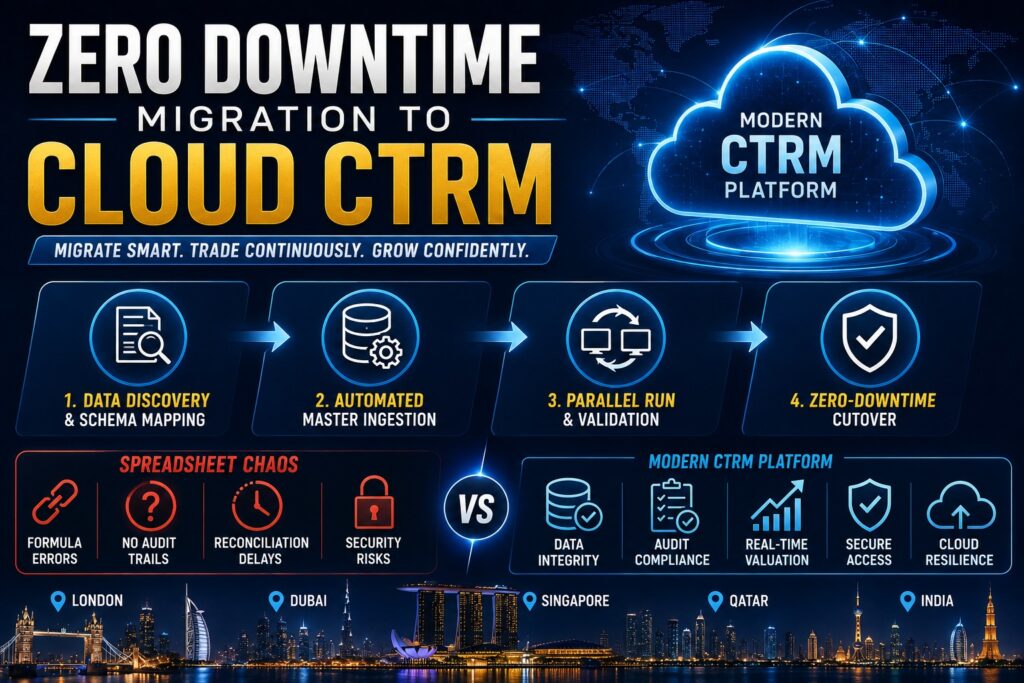
Table of Contents
- The Operational Trap of Spreadsheet-Based Trading
- Core Risks During Enterprise System Migration
- Why Modern CTRM Software Solutions Ensure Continuity
- A Step-by-Step Zero Downtime Migration Framework
- Feature Comparison: Spreadsheet Chaos vs. Modern CTRM Platform
- Regional Deployment: London, Dubai, Singapore, Qatar, and India
- Enterprise Architecture and Data Governance Standards
- Frequently Asked Questions About CTRM Software Solutions
- Next Steps for Trading Organizations
The Operational Trap of Spreadsheet-Based Trading
Spreadsheets offer fast flexibility when a trading firm launches its first commercial book.
However, trading operations expand rapidly across energy, metals, and agricultural products.
As transaction volumes scale, spreadsheet networks become fragile and difficult to control.
When trading organizations rely on manual workbooks, three major operational bottlenecks emerge:
- Formula Corruption: Accidental edits break pricing curves and valuation macros without warning.
- Lack of Audit Trails: Spreadsheets cannot record who edited trade terms or risk limits.
- Reconciliation Delays: Operations teams spend hours reconciling front-office deals with general ledger accounts.
Core Risks During Enterprise System Migration
Transitioning from spreadsheets to enterprise software involves substantial operational complexity.
First, commercial trading desks cannot pause live market trading during data migration.
Next, open physical contracts and paper hedges must transfer with absolute mathematical accuracy.
If historical price curves or settlement records migrate incorrectly, daily profit and loss calculations become distorted.
Furthermore, operations teams must maintain active credit monitoring with commercial financing banks. Therefore, trading organizations require a phased implementation strategy that avoids sudden system shutdowns.
+-----------------------------------------------------------------------------------+
|                        LEGACY DATA DISCOVERY & AUDIT                              |
|  • Ingest Historical Trade Books | Parse Unstructured Spreadsheet Macros          |
|  • Clean Counterparty Master Data | Normalize Open Physical & Derivative Contracts|
+-----------------------------------------------------------------------------------+
                                         |
                                         v
+-----------------------------------------------------------------------------------+
|                     PARALLEL RUN & REAL-TIME VALIDATION                           |
|  • Shadow Trade Capture: Dual Booking Across Spreadsheets & Cloud CTRM            |
|  • Real-Time Mark-to-Market & VaR Reconciliation Checks                           |
|  • Automated General Ledger Posting Verification on Microsoft Dynamics 365 Core   |
+-----------------------------------------------------------------------------------+
                                         |
                                         v
+-----------------------------------------------------------------------------------+
|               ZERO-DOWNTIME CUTOVER & COMPLETE RETIREMENT                         |
|  • Legacy Spreadsheets Locked | Live Operations Run Exclusively on Cloud CTRM     |
+-----------------------------------------------------------------------------------+
Why Modern CTRM Software Solutions Ensure Continuity
Enterprise commodity houses deploy specialized CTRM software solutions to eliminate manual data entry risks while preserving operational agility.
A purpose-built CTRM software solutions platform delivers immediate business benefits:
- Centralized Deal Capture: The system records physical trades, freight charters, and derivative orders in a single database.
- Automated Data Validation: It reconciles trade tickets against master credit agreements and KYC records automatically.
- Continuous System Availability: Cloud architecture provides high availability, enterprise backups, and disaster recovery.
In addition, modern CTRM software solutions integrate smoothly with corporate enterprise resource planning platforms.
A Step-by-Step Zero Downtime Migration Framework
A successful system migration follows four structured execution phases:
- Data Discovery and Schema Mapping: Clean historical counterparty records, contract templates, and pricing formulas.
- Automated Master Ingestion: Map legacy data structures directly into native enterprise database tables.
- Parallel Run Execution: Run legacy spreadsheets alongside the new cloud system for two to four weeks to verify settlement values.
- Final System Cutover: Decommission manual files once daily profit and loss numbers reconcile with zero variance.
As a result, operations teams switch to the new platform without disrupting ongoing trade execution.
Feature Comparison: Spreadsheet Chaos vs. Modern CTRM Platform
The differences between manual files and enterprise cloud systems impact daily trading efficiency directly:
| Operational Feature | Legacy Spreadsheet Models | Specialized CTRM Platform (Robosoft) |
| Data Integrity | Prone to formula breaks and broken workbook links. | Relies on relational databases with strict data validation. |
| Audit Compliance | Lacks automated user action logging. | Records immutable audit logs for every deal amendment. |
| Intraday Valuation | Requires manual workbook refreshes. | Recalculates position valuations and Greeks in real time. |
| User Access Security | Relies on basic password protection. | Enforces role-based permissions and multi-factor authentication. |
| Microsoft D365 Integration | Requires manual export and import scripts. | Runs natively inside Dynamics 365 Business Central and F&O. |
Regional Deployment: London, Dubai, Singapore, Qatar, and India
Deploying enterprise commodity software requires adherence to specific local market workflows:
- United Kingdom (London Desks): London desks focus on LME and ICE market connectivity, ensuring regulatory trade reporting compliance under UK statutory guidelines.
- United Arab Emirates (Dubai / DMCC): Middle Eastern trading entities integrate regional trade finance lines and designated free zone tax accounting.
- Singapore (Jurong Port Hub): APAC regional desks connect transshipment logistics with automated trade finance document verification.
- Qatar and Middle East Desks: Hydrocarbon producers coordinate long-term export supply contracts with real-time spot market netbacks.
- India (Domestic and Cross-Border): Indian commercial firms bridge domestic GST and mandi procurement with international futures hedging.
Enterprise Architecture and Data Governance Standards
Migrating mission-critical trading operations requires strict adherence to international IT security and data management standards.
Enterprise cloud deployments must follow cybersecurity and data migration guidelines outlined by the National Institute of Standards and Technology (NIST) Special Publication 800-145 Cloud Computing Guidelines.
Furthermore, organizations managing financial records must ensure continuous compliance with data security frameworks defined by the International Organization for Standardization (ISO) Information Security Standards.
Frequently Asked Questions About CTRM Software Solutions
Spreadsheets lack security controls, audit trails, and automated pricing feeds. Consequently, manual errors cause expensive operational mistakes and delayed financial reporting.
Dedicated CTRM software solutions utilize parallel run methodologies. Therefore, trading desks verify calculations in the new platform while keeping daily trading operations fully active.
A phased cloud deployment on pre-configured architectures typically takes between six to twelve weeks, depending on trade complexity and historical data clean-up requirements.
Yes. The migration toolkit cleans, maps, and ingests historical trade tickets, counterparty master data, and closed settlement ledgers into the new database.
Robosoft operates natively inside Microsoft Dynamics 365 data structures. As a result, physical trade bookings, logistics costs, and general ledger accounts update simultaneously with zero latency.
The system utilizes end-to-end data encryption, role-based access permissions, and automated verification checks to ensure complete data integrity.
Next Steps for Trading Organizations
Transitioning from manual spreadsheets to an enterprise commodity trading platform requires structured planning and proven technology.
- Discover how our unified Microsoft Dynamics 365 commodity ERP simplifies trade operations across your organization.
- Explore our specialized energy trading and risk management (ETRM) suite for comprehensive hydrocarbon portfolio control.
- Learn more about our Robosoft physical metal CTRM platform to streamline metal trade workflows.
- Contact our system migration specialists through our Robosoft Contact Page to schedule a technical architecture consultation.