Adopting modern CTRM software solutions is critical for commodity trading firms expanding across multiple physical asset classes. Diversified trading houses trade combinations of energy, base metals, grains, and soft commodities across global ports. However, operating separate software tools for each commodity desk creates data silos, delayed risk reporting, and expensive IT maintenance. In addition, legacy systems cannot calculate intraday Value at Risk (VaR) and cross-commodity margin calls in real time. Therefore, enterprise trading organizations implement unified cloud platforms to consolidate operations. Consequently, commercial desks eliminate data duplication, prevent compliance breaches, and protect corporate capital.
The Structural Limitation of Single-Commodity Legacy Architectures
Commodity trading enterprises frequently grow through rapid business expansion and acquisitions. Consequently, trading firms end up running separate software packages for oil desks, metals books, and agricultural supply chains.
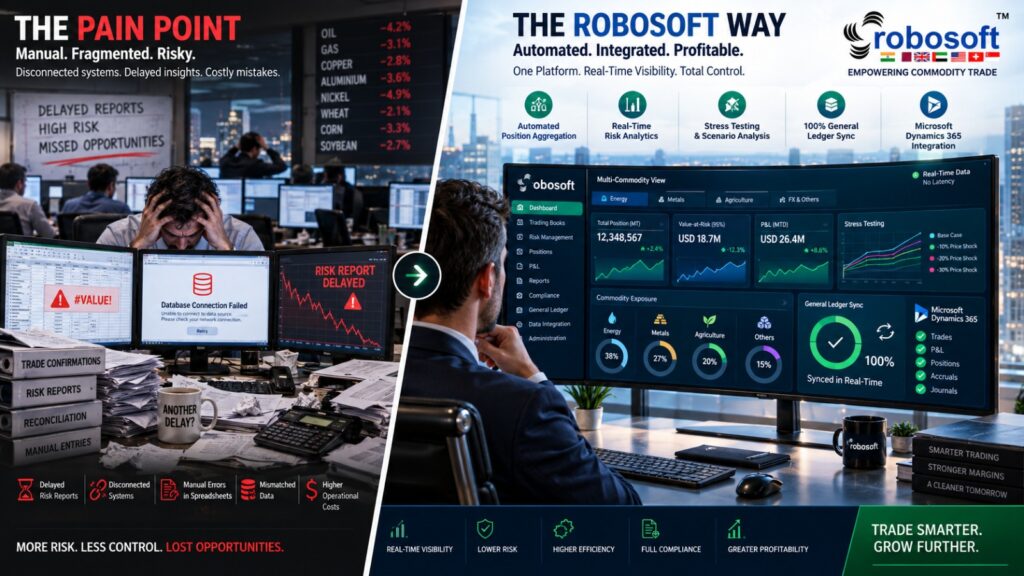
However, running isolated databases creates massive operational friction for executive leadership. When enterprise teams rely on fragmented software stacks, three major business bottlenecks emerge:
- Delayed Enterprise Risk Visibility: Risk managers must wait until end-of-day batch processing to calculate total corporate exposure.
- Expensive IT Maintenance: Maintaining custom interfaces between disconnected vendor tools increases infrastructure costs and integration downtime.
- Inconsistent Counterparty Limits: A single global counterparty may trade with multiple desks without treasury teams seeing total credit exposure.
Unified Risk Modeling: Intraday VaR, Stress Testing, and Greeks
Enterprise risk management requires continuous calculation of market exposures across volatile trading environments.
First, the risk engine ingests real-time market price feeds and forward curves from global exchanges. Next, the platform calculates historical and Monte Carlo Value at Risk (VaR) across all physical contracts and derivative hedges. Finally, risk managers execute dynamic stress tests simulating historical supply shocks, geopolitical events, and liquidity freezes.
Because spreadsheet models cannot calculate non-linear options Greeks across thousands of active deals, trading firms face unmonitored tail risk. Therefore, enterprise organizations require automated risk engines to monitor exposure thresholds continuously.
How Robosoft Solves Enterprise Multi-Commodity Bottlenecks
- Separate tools for oil, metals, and ags leave executives blind to cross-commodity risk.
- End-of-day batch jobs cause delayed margin calls and credit line overruns.
- Single enterprise database manages energy, metals, and agriculture seamlessly.
- Real-time calculation of portfolio VaR, Delta, Gamma, and counterparty credit limits.
- Native integration with Microsoft Dynamics 365 posts trade settlements instantly.
- Eliminates multi-vendor software license fees and delivers real-time corporate oversight.
Why Modern CTRM Software Solutions Deliver Unmatched Scalability
Growing commercial trading enterprises require high-performance CTRM software solutions that support rapid transaction growth without latency.
Direct Operational Benefits for Commercial Enterprises
Deploying dedicated CTRM software solutions provides distinct operational advantages:
- Unified Multi-Commodity Trade Capture: Deal makers enter bulk physical trades, vessel charter parties, and derivative hedges into a single interface.
- Automated Limit Breach Alerts: The system enforces automated pre-trade credit limits and position ceilings across all business units.
- Eliminates Middleware and API Fragility: Native enterprise architecture removes fragile data connectors between front-office and back-office accounting.
Furthermore, cloud scalability ensures system performance remains instantaneous during heavy market trading volume spikes.
Real-Time Position Aggregation Across Energy, Metals, and Agriculture
Global trading organizations must manage diverse physical supply chains alongside financial market hedges simultaneously.
The platform aggregates multi-asset risk using dynamic mathematical frameworks:
Portfolio VaR = √ [ ∑ (wi × σi)2 + 2 × ∑ ∑ (wi × wj × σi × σj × ρij) ]
Net Available Credit Headroom = Total Approved Counterparty Limit – (Open Physical Receivables + Mark-to-Market Exposure + Unsettled Invoices)
In these formulas, correlation parameters (ρij) account for diversification benefits across asset classes. Robosoft recalculates these variables instantly whenever market prices update. As a result, corporate treasurers optimize capital allocation across global trade finance facilities.
Feature Comparison: Multi-Vendor Stacks vs. Robosoft Cloud CTRM
Managing disconnected legacy applications cannot match the security, speed, and cost efficiency of a unified cloud platform:
| Enterprise Capability | Multi-Vendor Software Stack | Robosoft Unified Cloud CTRM |
|---|---|---|
| Multi-Asset Support | Requires separate platforms for energy, metals, and agriculture. | Manages all commodity classes natively within a single database. |
| Intraday VaR Calculations | Runs batch jobs overnight, leaving desks blind to intraday risk. | Calculates real-time VaR, Greeks, and stress tests continuously. |
| Global Counterparty Limits | Maintains fragmented credit limit records across separate desks. | Enforces unified, group-wide credit and exposure limits in real time. |
| Maintenance & Licensing | Incurs high annual support fees across multiple software vendors. | Reduces total cost of ownership on a single scalable platform. |
| Microsoft Dynamics 365 Core | Relies on third-party batch synchronization connectors. | Operates natively inside Dynamics 365 Business Central and F&O. |
International Data Governance and Risk Frameworks
Enterprise commodity trading operations must comply with recognized international regulatory guidelines and security benchmarks.
Cloud infrastructure governance and enterprise cybersecurity controls must align with directives defined by the National Institute of Standards and Technology (NIST) Cybersecurity Framework.
In addition, global derivative risk management and trade documentation standards follow rules established by the International Swaps and Derivatives Association (ISDA).
Furthermore, international financial reporting and hedge accounting compliance must satisfy governance standards set by the International Financial Reporting Standards (IFRS 9 Financial Instruments).
Frequently Asked Questions About CTRM Software Solutions
1. What are the key benefits of modern CTRM software solutions?
Modern solutions unify multi-commodity trade capture, automate intraday risk calculations, manage global counterparty limits, and eliminate manual spreadsheet reconciliations.
2. Why should diversified trading desks avoid separate single-commodity tools?
Using disconnected software for each commodity creates data silos and delays risk visibility. Consequently, trading firms face unmonitored credit exposures and higher software maintenance costs.
3. How do modern CTRM software solutions handle real-time risk modeling?
The system connects directly with live exchange price feeds. Therefore, risk managers evaluate portfolio VaR, option Greeks, and scenario stress tests with zero data latency.
4. Can the platform enforce global counterparty credit limits?
Yes. The software aggregates open trade exposure across all desks and branches, preventing deals that exceed corporate credit thresholds.
5. How does Robosoft connect with Microsoft Dynamics 365?
Robosoft operates natively inside Microsoft Dynamics 365 data structures. As a result, physical trade bookings, freight accruals, and financial ledgers update simultaneously with zero latency.
6. What commodities are supported across global operations?
The platform supports crude oil, refined petroleum, natural gas, LNG, base metals, precious metals, grains, oilseeds, biofuels, and soft commodities.
Next Steps for Enterprise Commodity Desks
Consolidating multi-commodity desks, automating enterprise risk calculations, and eliminating disconnected databases requires a purpose-built CTRM platform.
- Discover how our unified Microsoft Dynamics 365 commodity ERP simplifies enterprise trading operations.
- Explore our specialized energy trading and risk management software for comprehensive hydrocarbon control.
- Learn how our Robosoft physical metal CTRM platform automates global warehouse warrant management.
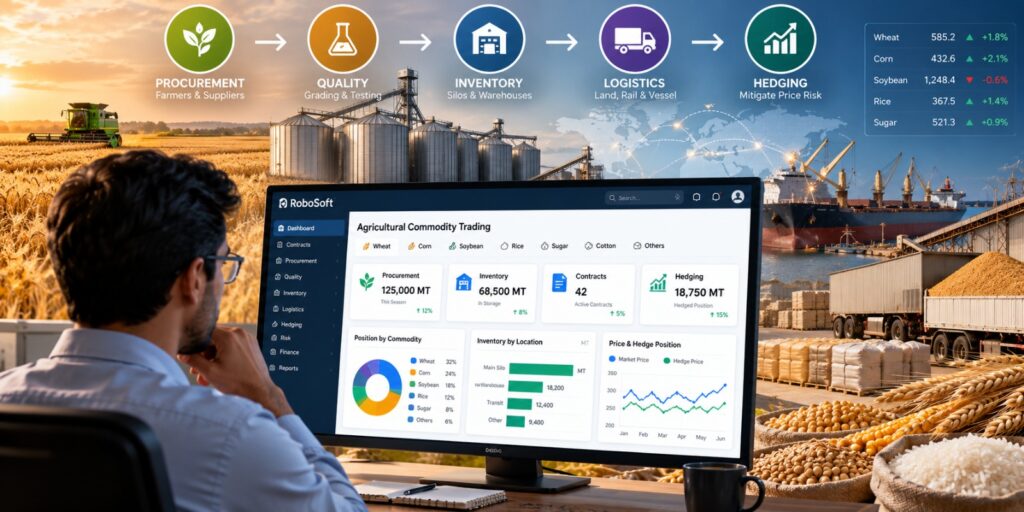
- Check our dedicated agricultural commodity trading software for bulk grain logistics.
- Contact our enterprise technology architects through our Robosoft Contact Page to schedule a technical architecture consultation.