Deploying specialized etrm software is essential for energy companies managing complex crude oil, refined product, and natural gas logistics. Upstream producers and midstream operators move millions of barrels through shared pipeline networks, storage tank farms, and marine terminals every day. However, manual spreadsheets cannot calculate volumetric pipeline shrinkage, temperature corrections, and joint venture allocations in real time. Therefore, modern energy enterprises implement connected platforms to automate hydrocarbon accounting. Consequently, commercial desks eliminate billing disputes, prevent terminal volume leaks, and protect trade margins.
The Operational Friction Between Upstream Production and Midstream Logistics
Hydrocarbon supply chains require seamless synchronization between field production, gathering networks, and regional transmission pipelines. Crude oil and gas liquids move continuously through custody transfer points across multiple owners.
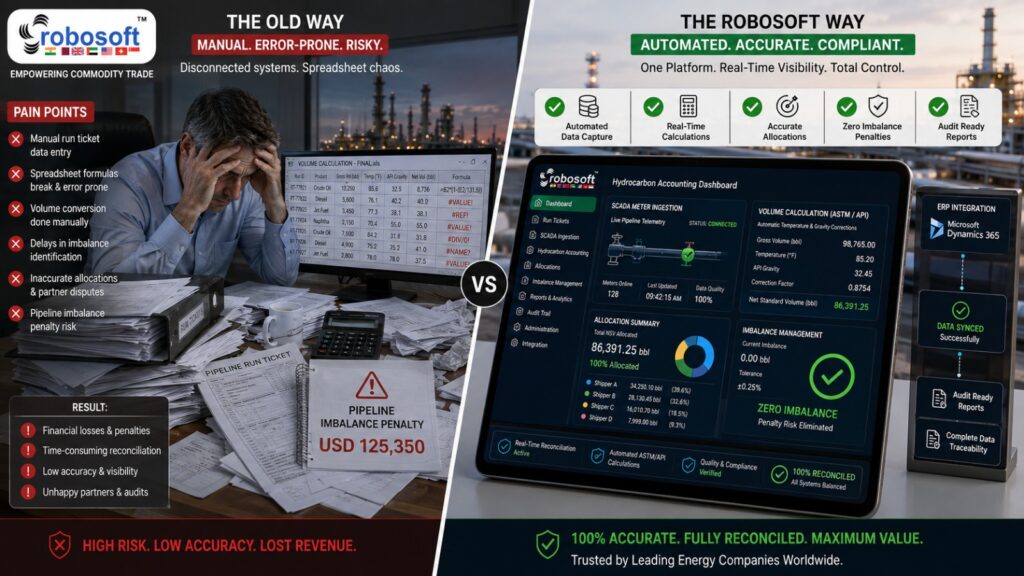
Consequently, operators must track ownership titles while physical molecules commingle inside shared pipeline systems. When midstream teams rely on disconnected legacy tools, critical operational problems arise:
- Allocation Inaccuracies: Discrepancies between field meter nominations and delivered terminal barrels trigger expensive partner audit disputes.
- Delayed Volumetric Accounting: Waiting days for manual run tickets delays monthly revenue settlements and cash collections.
- Unmonitored Pipeline Imbalances: Unreconciled injection and withdrawal differences create cash penalties from pipeline transmission operators.
Managing Pipeline Batching, Interface Cuts, and Transmix Losses
Pipelines transport diverse hydrocarbon grades sequentially in continuous batches through single common-carrier lines.
First, commercial dispatchers schedule batch injection sequences for light crude, condensate, or diesel. Next, the pipeline interface where two different products touch creates an off-spec mixture called transmix. Finally, operators must allocate transmix downgrade losses and re-refining costs fairly among participating shippers.
Because spreadsheet models cannot calculate multi-shipper batch movements dynamically, accounting teams face significant valuation errors. Therefore, energy enterprises require automated systems to track batch velocities, interface cuts, and shrinkage provisions continuously.
How Robosoft Eliminates Hydrocarbon Accounting Bottlenecks
- Operators manually re-type SCADA and meter tickets into spreadsheets.
- Transmix downgrades and thermal volume shrinkage cause disputed partner billings.
- Direct integration with SCADA meter feeds converts gross volume to net standard volume automatically.
- Automated batch tracking reconciles pipeline interface cuts and pro-rata transmix allocations.
- Native integration with Microsoft Dynamics 365 posts volumetric accounting to ledgers instantly.
- Settlement cycles drop from 15 days to under 24 hours with 100% auditable ownership tracking.
Why Modern ETRM Software Eliminates Midstream Accounting Bottlenecks
Hydrocarbon marketing and trading houses deploy dedicated etrm software to bridge physical field logistics with financial risk management.
Core Operational Benefits for Energy Desks
A dedicated etrm software platform connects physical nominations with back-office accounting ledgers:
- Automated Custody Transfer Accounting: The system captures electronic meter run tickets and verifies physical quantities against contractual delivery tolerances automatically.
- Integrated Terminal Throughput Tracking: It calculates tank storage fees, pumping throughput charges, and blending gain or loss adjustments per batch.
- Real-Time Pipeline Imbalance Management: Commercial managers monitor shipper linepack positions and daily cashout liabilities in real time.
Furthermore, unified architecture eliminates data re-entry between dispatch teams in the field and corporate treasury controllers.
Real-Time API Gravity Adjustments and Terminal Mass Balances
Physical hydrocarbon liquids expand and contract with temperature and pressure variations. Therefore, custody transfer settlements require converting observed gross volumes into Net Standard Volume (NSV) at sixty degrees Fahrenheit.
Modern platforms calculate standardized volumes using official ASTM and API tables automatically:
Net Standard Volume (NSV) = Gross Observed Volume × VCF × (1 – (S&W% / 100))
Net Landed Barrel Margin = Realized Sales Price – (Wellhead Cost + Gathering Tariff + Pipeline Tariff + Quality Deductions) ± Hedge PnL
In these formulas, the Volume Correction Factor (VCF) adjusts for temperature and API gravity, while Sediment and Water (S&W) deductions remove impurities. Robosoft calculates these variables instantly for every ticket. As a result, finance teams avoid costly invoicing errors on high-value bulk shipments.
Feature Comparison: Generic ERP vs. Specialized Robosoft ETRM
Generic corporate enterprise software cannot support the complex volumetric conversions and pipeline logistics required for hydrocarbon management:
| Operational Function | Generic Corporate ERP (e.g., SAP, Oracle) | Specialized Robosoft ETRM Platform |
|---|---|---|
| Temperature Volume Correction | Requires manual calculation before entering static inventory numbers. | Calculates ASTM / API Net Standard Volume automatically. |
| Pipeline Batch Tracking | Treats fluid movements as standard warehouse bin transfers. | Tracks active pipeline batches, interface transmix, and transit times. |
| Shipper Imbalance Reconciliation | Manages physical imbalances via month-end manual journal entries. | Tracks daily injection vs. withdrawal imbalances and cashouts live. |
| Terminal Tank Gains & Losses | Relies on static book inventory without mass balance reconciliation. | Reconciles tank strapping tables, roof displacements, and evaporation loss. |
| Microsoft Dynamics 365 Core | Requires expensive custom interfaces and maintenance middleware. | Operates natively inside Dynamics 365 Business Central and F&O. |
Official Industry Governance and Statutory Pipeline Directives
Hydrocarbon pipeline transportation, custody measurement, and contract accounting must comply with strict international regulatory standards.
Crude oil and petroleum product measurement procedures must follow technical guidelines established by the American Petroleum Institute (API) Manual of Petroleum Measurement Standards.
In addition, interstate pipeline tariffs, open-access transport rules, and capacity allocation directives adhere to governance set by the Federal Energy Regulatory Commission (FERC).
Furthermore, international energy market benchmark assessments and contract trade terms align with standards governed by the S&P Global Commodity Insights (Platts).
Frequently Asked Questions About ETRM Software
1. What is the primary role of ETRM software in midstream logistics?
It manages physical crude oil and gas nominations, tracks pipeline batch schedules, automates API gravity volume corrections, and reconciles terminal storage mass balances.
2. Why is dedicated ETRM software necessary for pipeline batching?
Specialized etrm software calculates product interface mixing and transmix downgrade losses automatically. Therefore, operators allocate actual physical yields accurately across multiple shippers.
3. How does the system handle API gravity temperature corrections?
The platform converts gross observed volumes into Net Standard Volume (NSV) at sixty degrees Fahrenheit using built-in ASTM/API measurement standards automatically.
4. Can the platform manage pipeline imbalance cashout settlements?
Yes. The platform tracks daily physical nominations against actual metered deliveries, calculating cashout liabilities based on contractual tariff tiers.
5. How does Robosoft connect with Microsoft Dynamics 365?
Robosoft operates natively inside Microsoft Dynamics 365 data structures. As a result, SCADA meter tickets, logistics tariffs, and general ledger accounts update simultaneously with zero latency.
6. What hydrocarbon commodities are supported by the software?
The software supports crude oil, natural gas, LNG, natural gas liquids (NGLs), condensate, refined petroleum products, and biofuels.
Next Steps for Hydrocarbon Operators
Eliminating pipeline reconciliation delays, automating temperature adjustments, and managing commodity risk requires an enterprise ETRM platform.
- Discover how our specialized energy trading and risk management software coordinates physical hydrocarbon trade lifecycles.
- Explore our comprehensive Microsoft Dynamics 365 commodity ERP to eliminate disconnected business systems.
- Learn how our marine bunker management software tracks fuel blending and terminal logistics.
- Contact our energy technology specialists through our Robosoft Contact Page to schedule a live product demonstration.