
By Neil Thornton, Principal CTRM Solutions Architect at Robosoft
Reviewed by Marcus Vance, Senior Metals Risk Specialist
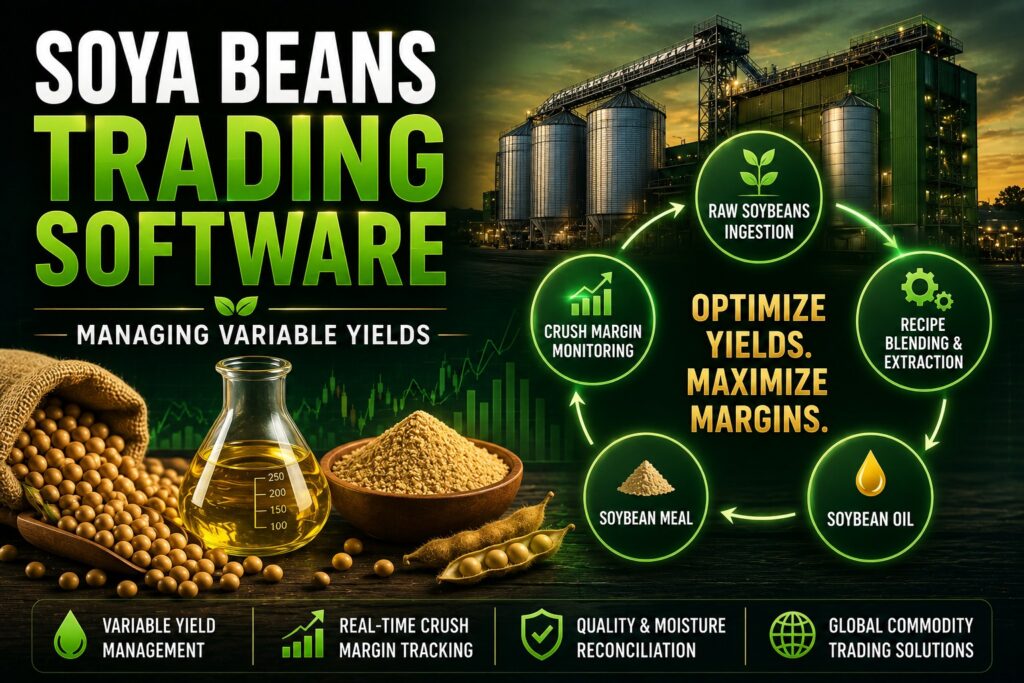
Deploying specialized soya beans trading software is vital for commercial agricultural processors and international trading houses. Soft commodity trading involves volatile processing yields, fluctuating crush margins, and variable moisture loss. In addition, manual spreadsheets cannot calculate multi-stage extraction losses across refining facilities in real time. Therefore, agribusinesses implement connected enterprise systems to automate recipe blending and monitor physical contract margins. Consequently, processing desks protect gross processing margins and eliminate settlement discrepancies.
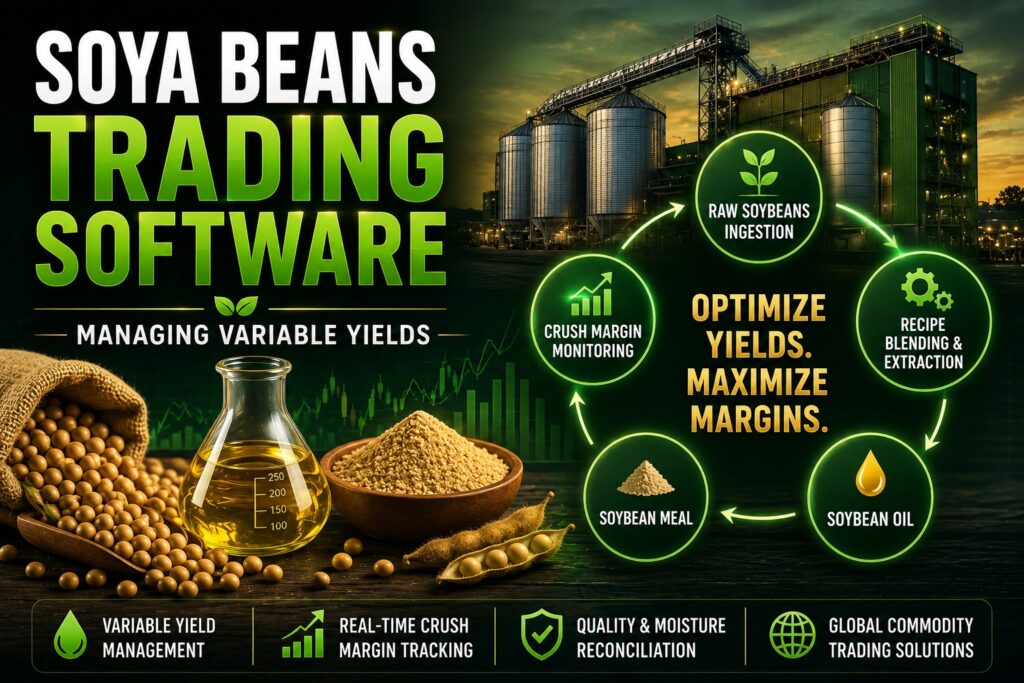
Table of Contents
- The Operational Challenge of Variable Extraction Yields
- Understanding the Dynamics of the Soya Crush Margin
- Why Specialized Soya Beans Trading Software Is Essential
- Automating Recipe Blending and Multi-Stage Processing
- Feature Comparison: Generic ERP vs. Specialized Agri CTRM
- Cross-Border Trade Corridors: India, Singapore, UK, and UAE
- Statutory Quality Standards and Contract Rules
- Frequently Asked Questions About Soya Beans Trading Software
- Next Steps for Soft Commodity Processors
The Operational Challenge of Variable Extraction Yields
Agricultural processing operations differ significantly from standard discrete manufacturing. Raw oilseeds arrive at crushing plants with fluctuating foreign matter, variable moisture content, and inconsistent oil levels.
Consequently, processing an identical tonnage of raw soybeans yields different proportions of soybean meal, crude degummed oil, and soybean hulls. When operations teams rely on static accounting models, several critical operational problems arise:
- Inaccurate Cost Allocation: Standard ledgers apply fixed yield ratios, distorting actual cost of goods sold per batch.
- Moisture Shrinkage Losses: Failing to track physical moisture loss during silo storage leads to inventory reconciliation write-offs.
- Delayed Quality Penalties: Manual quality deductions slow down provisional and final payments for incoming truck deliveries.
Understanding the Dynamics of the Soya Crush Margin
Commercial soybean processors manage risk by monitoring the gross processing margin, commonly known as the crush margin.
First, the processor purchases physical raw soybeans based on prevailing benchmark futures curves.
Next, the plant crushes the beans into approximately eighty percent soybean meal and eighteen to nineteen percent crude soybean oil.
Finally, the desk sells the processed meal and refined oil into feed and food manufacturing markets.
The gross processing margin reflects the price spread between raw input costs and combined co-product revenues:
$$\text{Gross Crush Margin} = (0.80 \times P_{\text{Meal}}) + (0.185 \times P_{\text{Oil}}) – P_{\text{Raw Soya Beans}} – \text{Processing Cost}$$
Because cash market prices for meal and oil shift independently from raw seed futures, margins can deteriorate rapidly. Therefore, risk managers must track physical crush margins alongside derivative board crush hedges continuously.
+-----------------------------------------------------------------------------------+
|                        RAW OILSEED HARVEST & INGESTION                            |
|  • Inbound Batch: 10,000 MT Raw Soybeans                                          |
|  • Inspection Metrics: 13.5% Moisture | 1.8% Foreign Matter | 19.2% Oil Content   |
+-----------------------------------------------------------------------------------+
                                         |
                                         v
+-----------------------------------------------------------------------------------+
|                     DYNAMIC RECIPE BLENDING & EXTRACTION ENGINE                   |
|  • Automated Silo Allocation & Shrinkage Deduction Applied                        |
|  • Real-Time Yield Split: 7,950 MT High-Protein Meal + 1,820 MT Crude Degummed Oil|
|  • Continuous Board Crush Hedge Matching across CBOT / NCDEX Derivatives          |
+-----------------------------------------------------------------------------------+
                                         |
                                         v
+-----------------------------------------------------------------------------------+
|               FINAL SETTLEMENT & MULTI-PRODUCT LEDGER UPDATE                      |
|  • Quality Discounts Reconciled | Real-Time Batch Gross Processing Margin Captured|
+-----------------------------------------------------------------------------------+
Why Specialized Soya Beans Trading Software Is Essential
Agribusiness enterprises implement dedicated soya beans trading software to bridge the gap between commercial trading, silo logistics, and plant production.
A purpose-built soya beans trading software solution automates complex processing workflows:
- Dynamic Yield Adjustments: The software updates co-product production yields dynamically based on inbound laboratory assay analyses.
- Automated Quality Discount Matrices: It applies contractual discount schedules for high moisture, split beans, and foreign matter automatically.
- Board Crush Hedge Tracking: It connects physical procurement commitments with derivative short positions on the CBOT, Dalian, or NCDEX exchanges.
Furthermore, integrating specialized soya beans trading software ensures that plant managers and trading desks share identical real-time inventory valuations.
Automating Recipe Blending and Multi-Stage Processing
Refined edible oil manufacturing requires precise component blending to achieve mandatory iodine values, color parameters, and melting points.
Modern blending engines calculate least-cost recipes automatically:
- Inbound Quality Capture: Records fatty acid composition and peroxide levels from storage tank samples.
- Formula Optimization: Calculates component ratios of crude palm oil, soybean oil, or sunflower oil to meet exact market specifications.
- Loss Reconciliation: Tracks neutralization losses, bleaching absorption, and deodorization yields across refinery stages.
As a result, operations teams minimize the usage of expensive bleaching earths and premium blend components while maintaining strict food safety compliance.
Feature Comparison: Generic ERP vs. Specialized Agri CTRM
Standard manufacturing software cannot support the variable chemistry and market-linked pricing of agricultural processing:
| Processing Capability | Standard Manufacturing ERP | Specialized Agri CTRM (Robosoft) |
| Yield Variance Tracking | Uses fixed bills of materials with manual variance journals. | Recalculates yields dynamically based on batch lab assays. |
| Crush Spread Hedging | Tracks financial hedges as disconnected accounting entries. | Links physical seed inputs with meal and oil derivative hedges. |
| Quality Deduction Matrices | Manages basic inventory weight without penalty tables. | Applies multi-parameter quality scale deductions automatically. |
| Silo & Tank Mass Balances | Relies on static warehouse bin tracking. | Tracks continuous silo shrinkage, aeration, and tank ullage. |
| Microsoft Dynamics 365 Core | Requires third-party synchronization scripts. | Runs natively inside Dynamics 365 Business Central and F&O. |
Cross-Border Trade Corridors: India, Singapore, UK, and UAE
Soft commodity supply chains operate across distinct regional regulatory and commercial environments:
- India (Domestic Crushing and Import Hub): Indian processors coordinate domestic soybean procurement from mandis with international crude degummed soybean oil imports, managing complex GST structures and domestic exchange hedges.
- Singapore (APAC Trading and Merchandising): Regional merchandising desks in Singapore manage large transshipments of Southeast Asian palm oil and South American soybeans into Asian consumer markets.
- United Kingdom and Europe: European traders track strict deforestation due diligence regulations (EUDR) and non-GMO traceability certificates directly against physical bulk shipments.
- United Arab Emirates (Dubai / Middle East): Regional edible oil refiners in the DMCC import crude vegetable oils for local processing and export across GCC markets.
Statutory Quality Standards and Contract Rules
International trade in oilseeds and refined vegetable oils must adhere to recognized commercial standards and arbitration bodies.
Global contracts for vegetable oils and oilseeds follow standardized trade rules established by the Federation of Oils, Seeds and Fats Associations (FOSFA) Contract Rules.
In addition, bulk grain and oilseed grading parameters must comply with official international quality definitions governed by the United States Department of Agriculture Federal Grain Inspection Service.
Frequently Asked Questions About Soya Beans Trading Software
1. What is the main purpose of soya beans trading software?
Soya beans trading software manages physical grain procurement, tracks variable processing yields, automates crush margin calculations, and coordinates derivative risk management.
2. Why is specialized soya beans trading software necessary for processing plants?
Dedicated soya beans trading software adjusts inventory valuations based on real-time extraction yields and moisture shrinkage. Therefore, finance teams track accurate production costs without manual spreadsheet corrections.
3. How does the system calculate automated quality discounts?
The platform compares lab analysis results against contractual baseline parameters. Consequently, it calculates discount deductions for high moisture or foreign matter automatically on settlement invoices.
4. Can the software track the commercial board crush margin?
Yes. The software links physical soybean purchase contracts with simultaneous futures hedges in soybean meal and soybean oil, providing real-time visibility over net processing spreads.
5. How does Robosoft connect with Microsoft Dynamics 365?
Robosoft runs directly on native Microsoft Dynamics 365 data structures. As a result, physical scale receipts, production yields, and general ledger accounts update simultaneously with zero data transfer delay.
6. Does the platform support edible oil blending recipes?
Yes. The system includes automated least-cost blending engines that optimize component ratios while satisfying strict quality specifications.
Next Steps for Soft Commodity Processors
Managing variable extraction yields, automated recipe blending, and complex crush margins requires a purpose-built commodity trading and ERP platform.
- Discover how our agro CTRM software for grain traders simplifies soft commodity trade lifecycles on Microsoft Dynamics 365.
- Explore our comprehensive Microsoft Dynamics 365 commodity ERP to eliminate disconnected manufacturing modules.
- Contact our agricultural technology specialists through our Robosoft Contact Page to schedule a live product demonstration.