
By Neil Thornton, Principal CTRM Solutions Architect at Robosoft
Reviewed by Marcus Vance, Senior Metals Risk Specialist
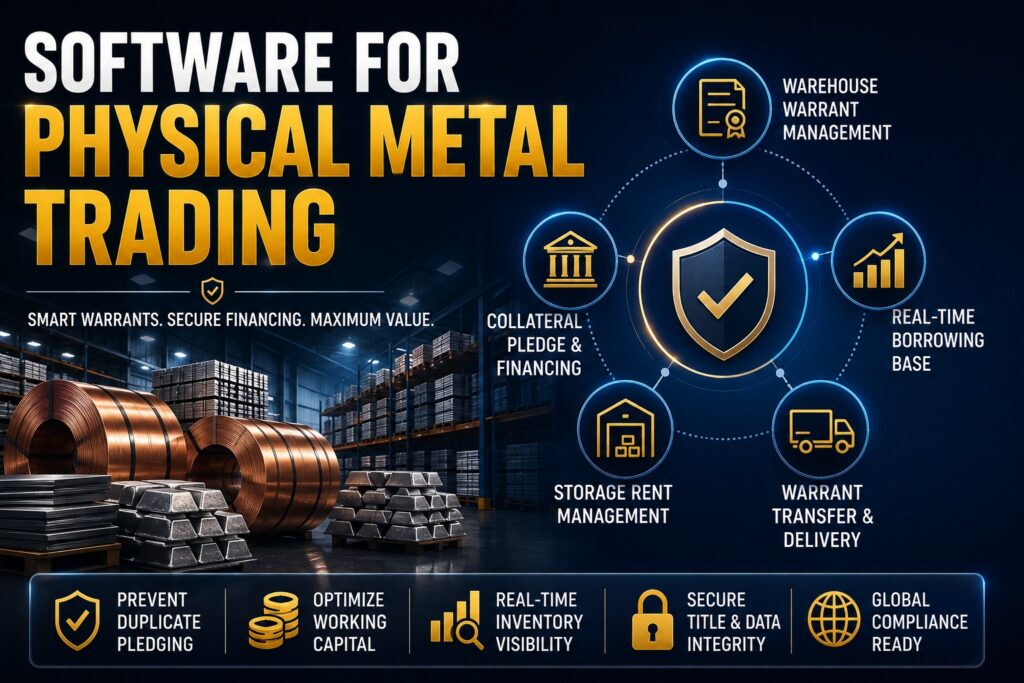
Deploying dedicated Software for physical metal trading has become essential for international trading desks managing base metals. Physical metal traders handle hundreds of bonded warehouse warrants, storage rent accruals, and collateral financing lines every day. In addition, manual spreadsheets cannot track electronic warrant ownership and bank pledges in real time. Therefore, trading organizations implement specialized systems to automate warrant reconciliations and optimize financing costs. Consequently, commercial metal desks prevent duplicate pledging and protect trade liquidity.
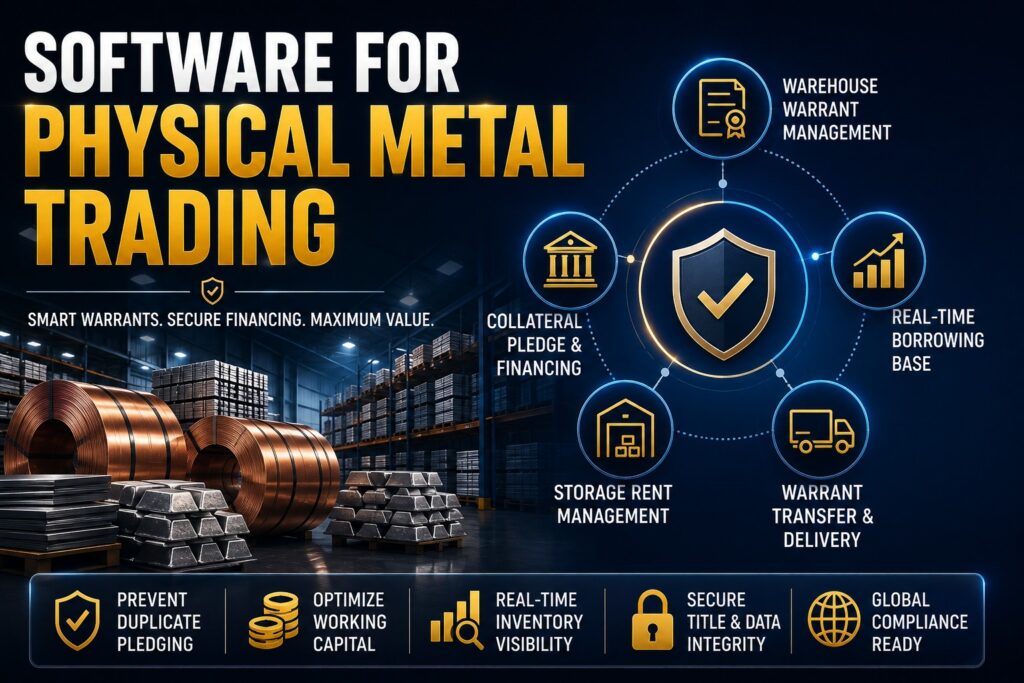
Table of Contents
- The Operational Complexity of Metal Warehouse Warrants
- Managing Collateral Pledges and Bank Borrowing Bases
- Why Software for Physical Metal Trading Is Vital for Warrants
- Automating Rent Accruals and LME Warehouse Transfers
- Feature Comparison: Legacy Spreadsheets vs. Modern Metals CTRM
- Key Commercial Warehousing Hubs: London, Singapore, and Dubai
- Statutory Warehouse Regulations and Compliance Standards
- Frequently Asked Questions About Software for Physical Metal Trading
- Next Steps for Physical Metal Desks
The Operational Complexity of Metal Warehouse Warrants
Physical base metals like copper, nickel, aluminum, and zinc trade via electronic warehouse warrants. A warehouse warrant represents a document of title for specific metal lots stored in licensed depositories.
However, managing thousands of warrants across multiple global locations creates significant operational challenges.
When trading desks manage warrant portfolios manually, several critical issues occur:
- Warrant Reconciliation Delays: Tracking title changes across London Metal Exchange (LMEsword) and private warehouse registries creates data delays.
- Storage Rent Calculation Errors: Warehouse rent rates vary by location, material grade, and package type.
- Financing Exposure Gaps: Lenders require instant proof of clear title before advancing working capital loans against stored metal.
Managing Collateral Pledges and Bank Borrowing Bases
Commercial metals desks rely on trade finance facilities to fund high-value inventory.
First, the trading house purchases physical metal parcels stored in approved warehouses.
Next, the desk pledges specific electronic warrant numbers to financing banks as loan security.
Finally, when the metal sells to an end-buyer, the bank releases the warrant hold upon payment receipt.
If metal market prices decline, banks demand instant loan margin repayments.
Because generic accounting tools cannot link live LME market curves with pledged warrant records, treasury teams struggle to calculate borrowing base headroom. Therefore, trading firms require integrated systems to monitor loan covenants and prevent margin breaches.
+-----------------------------------------------------------------------------------+
|                        PHYSICAL METAL INVENTORY RECEIPT                           |
|  • Material: 2,500 MT LME Grade A Copper Cathodes                                 |
|  • Location: Approved Bonded Warehouse (Jurong Port, Singapore)                   |
|  • Documentation: 100 Electronic Warehouse Warrants (25 MT / Warrant)             |
+-----------------------------------------------------------------------------------+
                                         |
                                         v
+-----------------------------------------------------------------------------------+
|                     AUTOMATED COLLATERAL PLEDGE & LOAN ENGINE                     |
|  • Warrants Pledged to Trade Finance Bank via Secure Registry Match               |
|  • Real-Time Borrowing Base Calculated: 85% Loan-to-Value (LTV) Ratio             |
|  • Daily Storage Rent & Insurance Charges Accrued Automatically                   |
+-----------------------------------------------------------------------------------+
                                         |
                                         v
+-----------------------------------------------------------------------------------+
|               FINAL COMMERCIAL DELIVERY & WARRANT RELEASE                         |
|  • Bank Pledge Released | Title Transferred | Net Trading Margin Realized         |
+-----------------------------------------------------------------------------------+
Why Software for Physical Metal Trading Is Vital for Warrants
Enterprise trading houses implement specialized Software for physical metal trading to bridge the gap between logistics, financing, and risk.
A modern Software for physical metal trading platform streamlines complex operations:
- Direct Warrant Registry Matching: The software synchronizes warrant numbers, brand names, and lot weights directly with electronic depository records.
- Dynamic Borrowing Base Tracking: It updates collateral valuations continuously as underlying LME and CME prices fluctuate.
- Automated Storage Accruals: It calculates daily warehouse rent and handling charges automatically across diverse storage contracts.
Furthermore, integrating dedicated Software for physical metal trading ensures zero data duplication between operations and corporate treasury teams.
Automating Rent Accruals and LME Warehouse Transfers
Metal warrants accrue daily storage rent and handling fees from the day of initial deposit.
Modern metal trading software calculates net carrying costs using automated storage matrices:
$$\text{Net Inventory Carrying Cost} = \sum (\text{Daily Storage Rate}_i \times \text{Days Held}) + \text{FOT In/Out Fees} + \text{Financing Interest}$$
- In this formula, the variable $\text{Daily Storage Rate}_i$ reflects specific location and grade charges.
- The term $\text{FOT In/Out Fees}$ accounts for Free On Truck loading and unloading costs charged by warehouse operators.
As a result, operations teams calculate exact landed carrying costs before executing cash-and-carry financing transactions.
Feature Comparison: Legacy Spreadsheets vs. Modern Metals CTRM
Generic corporate tools cannot support the fast-moving logistics of warrant trading:
| Operational Capability | Manual Spreadsheet Tracking | Specialized Metals CTRM (Robosoft) |
| Electronic Warrant Tracking | Requires manual data entry of individual warrant numbers. | Ingests electronic warrant files directly from depository registries. |
| Borrowing Base Calculations | Relies on delayed weekly inventory estimates. | Updates collateral valuations in real time against live market prices. |
| Storage Rent Accruals | Calculates rent retrospectively via manual invoices. | Accrues daily storage and handling costs automatically. |
| Assay & Brand Matching | Lacks automated verification of producer brands. | Validates registered LME and non-LME producer brands automatically. |
| Microsoft Dynamics 365 Core | Operates as an unlinked external tracking sheet. | Runs natively inside Dynamics 365 Business Central and F&O. |
Key Commercial Warehousing Hubs: London, Singapore, and Dubai
Physical metal storage and financing depend heavily on established global trade logistics centers:
- Singapore (Jurong Port Logistics Hub): Singapore is a major storage center for Asian base metals. Desks in Singapore utilize integrated systems to track bonded warehouse inventory and export manifests.
- United Kingdom (London LME Hub): London desks manage large warrant positions across licensed European and British storage facilities.
- United Arab Emirates (Dubai / DMCC): Dubai provides secure depository infrastructure for precious and base metals, enabling fast cross-border transshipments.
- India (Domestic and Transit Metals): Indian metal desks bridge domestic warehouse receipts with international warrant financing facilities.
- Qatar and Middle East Desks: Regional producers track outbound metal shipments and port storage allocations across international distribution hubs.
Statutory Warehouse Regulations and Compliance Standards
Warehouse warrant transfers and collateral financing must adhere to strict international trade standards.
Metal depository operations and warrant delivery mechanisms follow rules established by the London Metal Exchange Warehouse Operating Standards.
In addition, cross-border collateral pledge agreements follow international security frameworks governed by the International Chamber of Commerce Uniform Rules for Collections.
Frequently Asked Questions About Software for Physical Metal Trading
1. What is the role of specialized software in metal warrant management?
Specialized software tracks electronic warehouse warrants, calculates storage rent accruals, and automates bank collateral financing for metal trading houses.
2. Why is specialized software for physical metal trading necessary for collateral loans?
Dedicated Software for physical metal trading recalculates collateral borrowing values in real time. Therefore, treasury teams prevent unexpected margin calls from financing banks.
3. How does the system track storage rent and warehouse handling fees?
The platform records daily rent rates for each storage facility. Consequently, it calculates cumulative rent and truck handling fees automatically until warrants are cancelled or sold.
4. Can the software prevent duplicate warrant pledging?
Yes. The software locks pledged warrant numbers in the database, preventing traders from assigning the same inventory to multiple banking facilities.
5. How does Robosoft connect with Microsoft Dynamics 365?
Robosoft operates natively inside Microsoft Dynamics 365 tables. As a result, warrant inventory movements, loan balances, and general ledger accounts update simultaneously with zero latency.
6. What metal categories can the platform track?
The platform manages base metals, precious metals, minor metals, steel products, scrap metal, and bulk concentrate inventories.
Next Steps for Physical Metal Desks
Managing electronic warehouse warrants, collateral loan facilities, and daily storage accruals requires a purpose-built commodity trading engine.
- Discover how our Robosoft physical metal CTRM platform simplifies metal trade operations on Microsoft Dynamics 365.
- Explore our comprehensive Microsoft Dynamics 365 commodity ERP to eliminate disconnected middleware.
- Reach out to our metals solutions team through our Robosoft Contact Page to schedule a live product demonstration.