
By Neil Thornton, Principal CTRM Solutions Architect at Robosoft
Reviewed by Marcus Vance, Senior Metals Risk Specialist
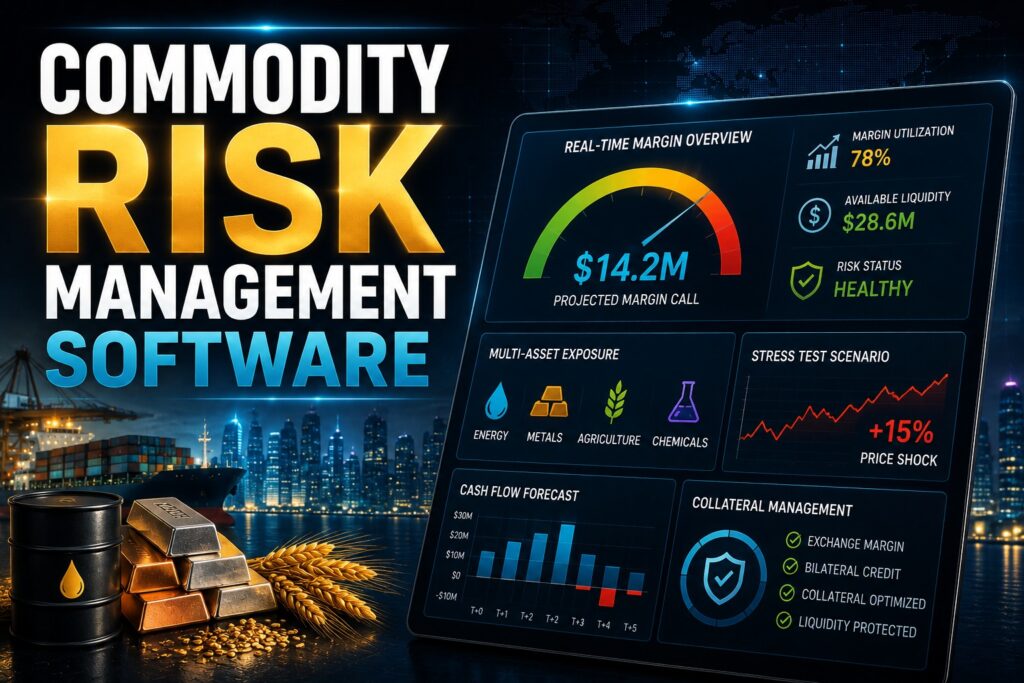
Deploying dedicated commodity risk management software is essential for commercial trading desks facing extreme market volatility. Physical and derivative commodity portfolios experience sudden initial margin spikes and variation margin calls across multiple exchanges. Therefore, trading firms need real-time cash flow forecasting and automated collateral management to protect enterprise liquidity. Consequently, commercial desks can eliminate funding bottlenecks and prevent forced liquidation of profitable hedge positions.
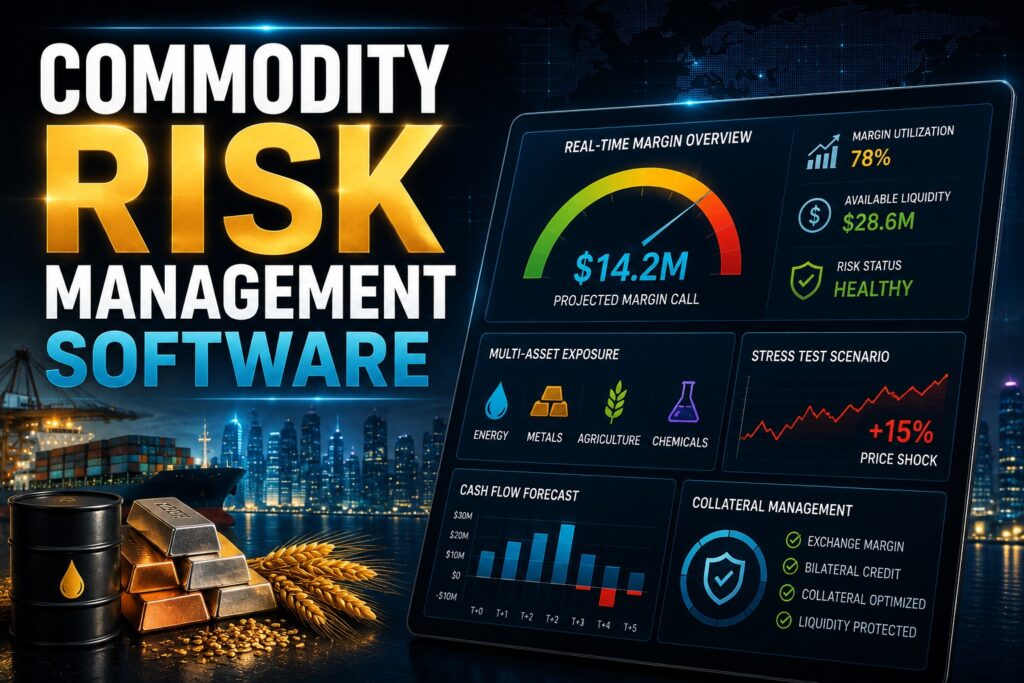
Table of Contents
- The Challenge of Extreme Commodity Price Swings
- Managing Exchange Margin Calls and Bilateral Credit Lines
- Why Dedicated Commodity Risk Management Software Is Essential
- Consolidating Multi-Asset Margin and Liquidity Portfolios
- Feature Comparison: Legacy Spreadsheets vs. Modern Risk Engines
- Cross-Border Execution: London, Dubai, Singapore, and India
- Statutory Standards and Financial Market Directives
- Frequently Asked Questions About Commodity Risk Management Software
- Next Steps for Commodity Risk Desks
The Challenge of Extreme Commodity Price Swings
Global commodity markets experience sudden price volatility across energy, metals, and agricultural sectors. When energy benchmarks or metal curves spike unexpectedly, clearing brokers raise margin requirements immediately.
Consequently, trading houses face substantial intraday capital demands. When risk managers rely on static spreadsheets, critical liquidity bottlenecks occur:
- Cash Buffer Depletion: Unexpected variation margin calls drain available bank credit lines rapidly.
- Delayed Cash Forecasting: Treasury teams struggle to forecast cash requirements across multiple clearing brokers.
- Hedge Inefficiencies: Desks liquidate derivative hedges prematurely to satisfy short-term cash deficits.
Managing Exchange Margin Calls and Bilateral Credit Lines
Commodity trading houses trade on centralized exchanges and over-the-counter (OTC) bilateral markets simultaneously.
First, exchange-cleared futures contracts on the LME, ICE, and CME require strict daily cash variation margin.
In contrast, bilateral physical agreements often rely on credit support annexes and letters of credit.
If energy prices double overnight, exchange accounts demand instant cash transfers. Meanwhile, physical cash receipts arrive weeks later upon cargo discharge.
Because traditional accounting systems cannot forecast dynamic cash gaps, firms face severe funding squeezes. Therefore, risk managers must automate margin call projections before clearing brokers issue settlement notices.
+-----------------------------------------------------------------------------------+
|                        MULTI-ASSET TRADE POSITION FEED                            |
|  • Physical Portfolio: 50,000 MT Fuel Oil + 10,000 MT Copper Cathode              |
|  • Derivative Hedges: ICE Brent Swaps + LME Copper Futures Short Positions        |
+-----------------------------------------------------------------------------------+
                                         |
                                         v
+-----------------------------------------------------------------------------------+
|                     DYNAMIC STRESS TESTING & MARGIN SIMULATION                    |
|  • Scenario: 15% Upward Price Spike in Underlying Commodity Curves                |
|  • Projected Variation Margin Call: $14.2M Due at 09:00 T+1                       |
|  • Real-Time Treasury Match: Uncommitted Bank Revolver Line Allocated             |
+-----------------------------------------------------------------------------------+
                                         |
                                         v
+-----------------------------------------------------------------------------------+
|               AUTOMATED COLLATERAL DISPATCH & HEDGE INTEGRITY                     |
|  • Margin Settled | Zero Liquidation Distress | Consolidated P&L Protected        |
+-----------------------------------------------------------------------------------+
Why Dedicated Commodity Risk Management Software Is Essential
Enterprise trading houses implement specialized commodity risk management software to unify physical deals, futures hedges, and treasury lines.
A purpose-built commodity risk management software solution automates complex liquidity workflows:
- Automated Margin Simulation: The software calculates exchange initial margin and potential variation margin calls under extreme stress conditions.
- Consolidated Cash Visibility: It aggregates bank credit balances, collateral deposits, and letters of credit into a single dashboard.
- Integrated Hedge Accounting: It aligns physical inventory valuations with derivative mark-to-market positions automatically.
Furthermore, an integrated commodity risk management software platform reduces manual reconciliation errors between front-office traders and back-office treasury teams.
Consolidating Multi-Asset Margin and Liquidity Portfolios
Managing multi-commodity books requires dynamic portfolio risk modeling. For this reason, modern systems track net open positions across different asset classes.
The risk engine evaluates net liquidity requirements using automated scenario testing:
$$\text{Net Liquidity Requirement} = \sum (\text{VM}_{\text{Exchange}}) + \sum (\text{IM}_{\text{Adjusted}}) + \text{Operational Cash Reserve} – \text{Available Credit Facilities}$$
- In this formula, $\text{VM}_{\text{Exchange}}$ represents the daily variation margin payable across all cleared accounts.
- The variable $\text{IM}_{\text{Adjusted}}$ reflects the stressed initial margin required by clearing houses during volatile sessions.
As a result, treasury teams allocate working capital efficiently across multiple trading desks without holding excessive idle cash reserves.
Feature Comparison: Legacy Spreadsheets vs. Modern Risk Engines
Traditional treasury spreadsheets cannot match the analytical speed of modern commodity risk platforms:
| Risk Capability | Manual Spreadsheet Models | Specialized Risk Suite (Robosoft) |
| Intraday Margin Projections | Relies on retrospective broker recap statements. | Simulates exchange margin calls in real time against live curves. |
| Multi-Asset Portfolio Stressing | Models single asset classes in isolated files. | Stresses oil, gas, metals, and agricultural books in one model. |
| Credit Facility Monitoring | Involves manual ledger cross-checks. | Tracks bilateral bank covenants and credit headroom live. |
| Cash Call Automation | Requires manual wire transfer calculations. | Automates cash call validation against clearing broker data. |
| Microsoft Dynamics 365 Core | Operates as a disconnected external spreadsheet. | Runs natively inside Dynamics 365 Business Central and F&O. |
Cross-Border Execution: London, Dubai, Singapore, and India
Global trading firms manage liquidity across diverse international regulatory environments:
- United Kingdom (London Desks): London-based desks managing LME and ICE positions must comply with strict margin rules and UK EMIR reporting guidelines.
- United Arab Emirates (Dubai / DMCC): Middle Eastern energy and bullion trading houses utilize multi-currency liquidity pools to fund physical trade operations.
- Singapore (APAC Regional Hub): Singapore desks link SGX margin accounts with regional bank trade finance facilities in Jurong.
- India (Domestic and Cross-Border): Indian commercial houses balance domestic MCX and NCDEX margin buffers with international forward hedging commitments.
- Qatar and Middle East Desks: Hydrocarbon producers use liquidity controls to manage credit exposure on long-term supply agreements.
Statutory Standards and Financial Market Directives
Commodity derivatives trading desks must adhere to official financial market directives and risk regulations.
Firms trading derivative contracts in Europe and the UK must maintain compliant margin reserves under the European Securities and Markets Authority (ESMA) EMIR Directives.
Furthermore, international financial institutions and commodity clearing members follow collateral guidelines set by the Basel Committee on Banking Supervision Standards.
Frequently Asked Questions About Commodity Risk Management Software
1. What is the primary role of commodity risk management software?
Commodity risk management software monitors market risk, calculates Value at Risk (VaR), tracks margin requirements, and manages liquidity for physical and financial trading desks.
2. Why is specialized commodity risk management software necessary during market volatility?
Dedicated commodity risk management software simulates clearing house margin hikes in advance. Therefore, treasury teams arrange necessary credit lines before margin calls become due.
3. How does the software track variation margin across multiple brokers?
The system ingests electronic trade feeds and reconciles broker statements automatically. Consequently, finance teams identify billing discrepancies and settle exact cash requirements promptly.
4. Can the platform model cross-commodity portfolio risk?
Yes. The platform models risk across crude oil, refined products, natural gas, base metals, and agricultural products in a unified risk engine.
5. How does Robosoft integrate with Microsoft Dynamics 365?
Robosoft connects natively with Microsoft Dynamics 365 tables. As a result, risk valuations, credit allocations, and cash ledgers update simultaneously with zero data transfer delay.
6. Does the software support letter of credit (LC) tracking?
Yes. The system monitors letter of credit issuance, expiry dates, bank drawing fees, and counterparty credit lines directly against physical trade contracts.
Next Steps for Commodity Risk Desks
Protecting your trading enterprise against sudden margin shocks and liquidity shortages requires an automated risk and treasury platform.
- Discover how our energy trading and risk management (ETRM) suite optimizes physical and derivative risk on Microsoft Dynamics 365.
- Explore our comprehensive Microsoft Dynamics 365 commodity ERP to eliminate disconnected risk models.
- Reach out directly to our risk architects through our Robosoft Contact Page to schedule a live product demonstration.