
By Aakash Verma, Principal CTRM Solutions Architect at Robosoft
Reviewed by Marcus Vance, Senior Metals Risk Specialist
Deploying dedicated metal trading CTRM software is essential for physical metal trading houses. Standard corporate ERP platforms manage static manufacturing inventories effectively. However, traditional enterprise systems cannot handle dynamic commodity variables. For example, metal trades involve variable assay purity, fluctuating moisture loss, and shifting quotational periods. Therefore, trading desks need specialized systems to protect operating margins and automate complex settlement pricing.
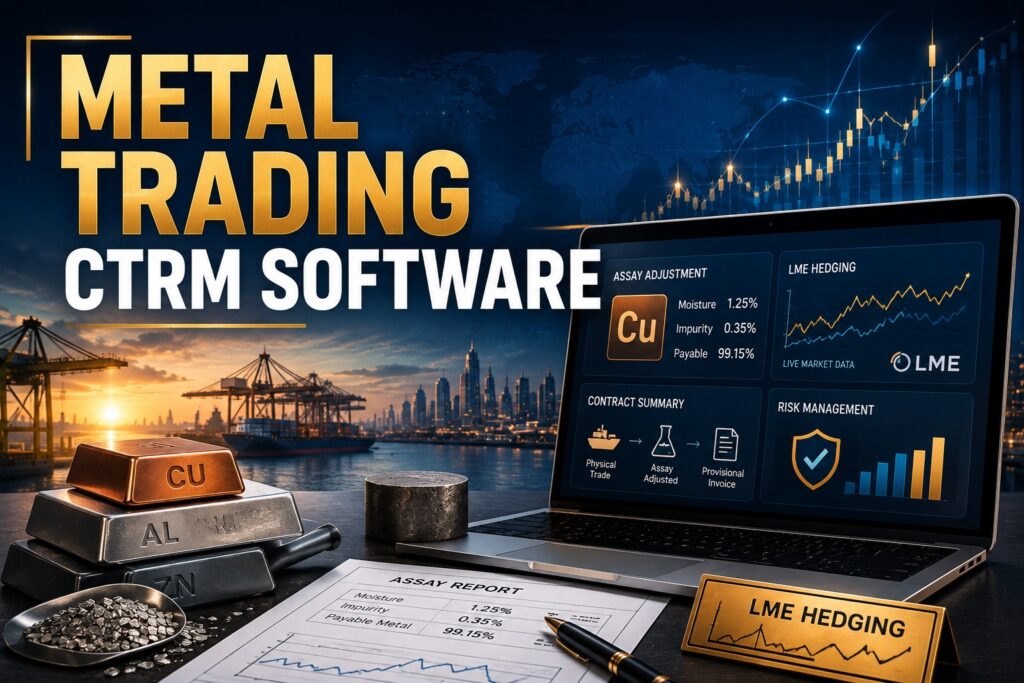
Table of Contents
- The Core Limitations of Traditional Manufacturing ERPs
- Managing Variable Assay Adjustments and Moisture Loss
- Quotational Periods and Live LME Market Valuation
- Why Specialized Metal Trading CTRM Software Solves the Gap
- Feature Comparison: Generic ERP vs. Specialized Metals CTRM
- Cross-Border Trade Hubs: London, Dubai, and Singapore
- Statutory Exchange Frameworks and Compliance Standards
- Frequently Asked Questions About Metal Trading CTRM Software
- Next Steps for Metal Trading Desks
The Core Limitations of Traditional Manufacturing ERPs
Standard enterprise resource planning systems were designed for discrete manufacturing. In those environments, a product unit maintains a fixed bill of materials and standard production costs.
In contrast, physical metal trading operates under volatile market conditions. Metal parcels change in value, chemical composition, and physical mass during transit.
When trading desks force metal operations into generic ERPs, operations teams face critical bottlenecks:
- Inflexible Unit Tracking: Generic ERPs track items by static piece counts or gross weights. However, physical metal value depends strictly on dry weight and payable metal purity.
- Disconnected Accounting: Standard ledgers cannot issue provisional settlement invoices. As a result, finance teams manage contract adjustments in manual external spreadsheets.
- Delayed Exposure Reporting: Traditional systems update inventory valuations retrospectively. Consequently, risk managers cannot view live mark-to-market valuations across volatile trading books.
Managing Variable Assay Adjustments and Moisture Loss
Physical metal concentrates, ores, and scrap materials never arrive with uniform chemical purity. For this reason, contracts require provisional payments followed by final assay settlements.
First, a buyer pays an initial invoice based on estimated moisture and baseline metal content.
Next, independent inspection labs sample the shipment at the discharge port to determine exact moisture loss and chemical penalties.
Finally, the buyer and seller exchange split assay results. If the results differ beyond agreed tolerances, an independent umpire laboratory determines the final payable metal content.
Because generic ERPs lack automated assay deduction tables, finance teams must calculate penalty deductions manually. Therefore, settlement errors increase and cash collections slow down significantly.
Quotational Periods and Live LME Market Valuation
Metal contracts rarely trade at a single fixed cash price. Instead, pricing references a future Quotational Period (QP) on the London Metal Exchange (LME) or CME Group.
For instance, a copper cathode contract agreed in August might price using the October average LME cash settlement price:
$$\text{Final Settlement Value} = (\text{Dry Metric Tons} \times \text{Payable Purity \%}) \times (\text{Average LME QP Price} \pm \text{Physical Premium}) – \text{Penalties}$$
Generic accounting systems cannot link open contracts to live forward curves. Consequently, risk teams cannot determine whether open physical contracts are gaining or losing value before final QP fixation. Furthermore, hedging desks struggle to align physical purchase fixations with matching derivative short positions.
Why Specialized Metal Trading CTRM Software Solves the Gap
Commodity trading firms implement purpose-built metal trading CTRM software to unify physical logistics, risk valuation, and back-office accounting.
A dedicated metal trading CTRM software platform automates the entire trade lifecycle:
- Automated Assay Deductions: The software calculates split assays, umpire lab reconciliations, and penalty matrices automatically.
- Dynamic MTM Valuation: It recalculates open physical contract values continuously against live LME and CME forward pricing curves.
- Collateral and Warrant Management: It tracks electronic warehouse warrants, pledged collateral lines, and multi-currency trade financing facilities.
+-----------------------------------------------------------------------------------+
|                        PHYSICAL METAL CONTRACT CAPTURE                            |
|  • Material: Copper Concentrates (1,500 DMT)                                      |
|  • Pricing: LME Cash QP (M+2 Average) + Physical Premium                          |
|  • Terms: 90% Provisional Payment | 10% Final Settlement                          |
+-----------------------------------------------------------------------------------+
                                         |
                                         v
+-----------------------------------------------------------------------------------+
|                     AUTOMATED ASSAY & MOISTURE RECONCILIATION                     |
|  • Loading Port Baseline: 28.5% Cu | 8.2% Moisture                                |
|  • Discharge Inspection: 27.9% Cu | 9.1% Moisture | Arsenic Penalty Applied       |
|  • Split Assay Tolerance Check & Automated Umpire Matrix Evaluation               |
+-----------------------------------------------------------------------------------+
                                         |
                                         v
+-----------------------------------------------------------------------------------+
|               FINAL COMMERCIAL SETTLEMENT & LME HEDGE UNWIND                      |
|  • Provisional Invoice Reconciled | Final Trade Margin Realized                   |
+-----------------------------------------------------------------------------------+
Feature Comparison: Generic ERP vs. Specialized Metals CTRM
The differences between standard manufacturing platforms and specialized commodity software impact daily trading operations directly:
| Operational Feature | Generic ERP (e.g., SAP, Oracle) | Specialized Metals CTRM (Robosoft) |
| Provisional vs. Final Invoicing | Requires complex manual credit notes and external spreadsheets. | Generates automated washouts, provisional advances, and final invoices. |
| Assay Deduction Logic | Manages basic gross weight without impurity penalty matrices. | Applies multi-element penalty deduction tables automatically. |
| Quotational Period Pricing | Uses static cost accounting with manual journal entries. | Tracks floating QP curves with automatic daily mark-to-market revaluations. |
| Warehouse Warrant Controls | Treats stock as static warehouse bins. | Manages electronic LME warehouse warrants and pledged financing. |
| Enterprise Architecture | Requires expensive custom middleware connectors. | Runs natively inside Microsoft Dynamics 365 Business Central and F&O. |
Cross-Border Trade Hubs: London, Dubai, and Singapore
Global physical metal supply chains rely on specific regional market mechanisms:
- United Kingdom (London Desks): London is the center of global base metals price discovery. Desks managing physical LME warrants use specialized systems to calculate daily backwardation or contango financing costs.
- United Arab Emirates (Dubai / DMCC Hub): Dubai acts as a key global gateway for physical gold, scrap metal, and aluminum. Traders operating in the DMCC require automated VAT handling and swift export documentation.
- Singapore (Jurong Port): Singapore serves as Southeast Asia’s critical transshipment hub. Desks utilize integrated software to monitor bonded warehouse stocks and transit blending across regional ports.
- India (Domestic and Export Desks): Indian metals desks bridge domestic mandi pricing and Multi Commodity Exchange (MCX) hedging with international import documentation.
Statutory Exchange Frameworks and Compliance Standards
Physical metal trading operations must comply with official exchange guidelines and international trade reporting rules.
Traders managing exchange-cleared inventories must adhere to the physical delivery standards and warehouse rules established by the London Metal Exchange Trading and Delivery Regulations.
In addition, international physical commodity contracts follow standardized trade definitions governed by the International Chamber of Commerce Incoterms Rules.
Frequently Asked Questions About Metal Trading CTRM Software
Standard ERPs assume fixed product costs and uniform inventory units. In contrast, physical metals trade on floating exchange prices, variable chemical purities, and multi-stage provisional settlements.
Dedicated metal trading CTRM software applies automated deduction matrices for moisture loss and element impurities. Therefore, finance teams settle final invoices accurately without manual spreadsheet calculations.
The software tracks daily price curve movements on the LME and CME. Consequently, risk managers maintain clear visibility over floating physical exposures and hedge ratios until pricing fixations complete.
Yes. The platform tracks warrant numbers, depository locations, and collateral pledges directly against physical contract records.
Robosoft operates directly on native Microsoft Dynamics 365 tables. As a result, trade entries, inventory adjustments, and general ledger postings update simultaneously without data transfer delays.
The platform supports refined base metals, minor metals, precious metals, bulk ores, metal concentrates, and recycled scrap materials.
Next Steps for Metal Trading Desks
Managing physical metal contracts, assay reconciliations, and exchange-linked risk requires a purpose-built commodity trading engine.
- Discover how our Robosoft physical metal CTRM platform simplifies metal trade workflows on Microsoft Dynamics 365.
- Explore our unified Microsoft Dynamics 365 commodity ERP to eliminate disconnected third-party integrations.
- Connect with our trading technology specialists through our Robosoft Contact Page to schedule a live product demonstration.