
Why Generic ERPs Fail in Commodity Trading for Metals. The days of easy margins are over. In 2025, a specific market shift is happening: Global Zinc supply is rising, but construction demand is weakening. This volatility exposes the cracks in generic software. Commodity trading for metals requires a level of precision that standard ERPs simply cannot provide. If your system relies on spreadsheets to handle scrap yield and alloy blending, you are losing money on every deal.
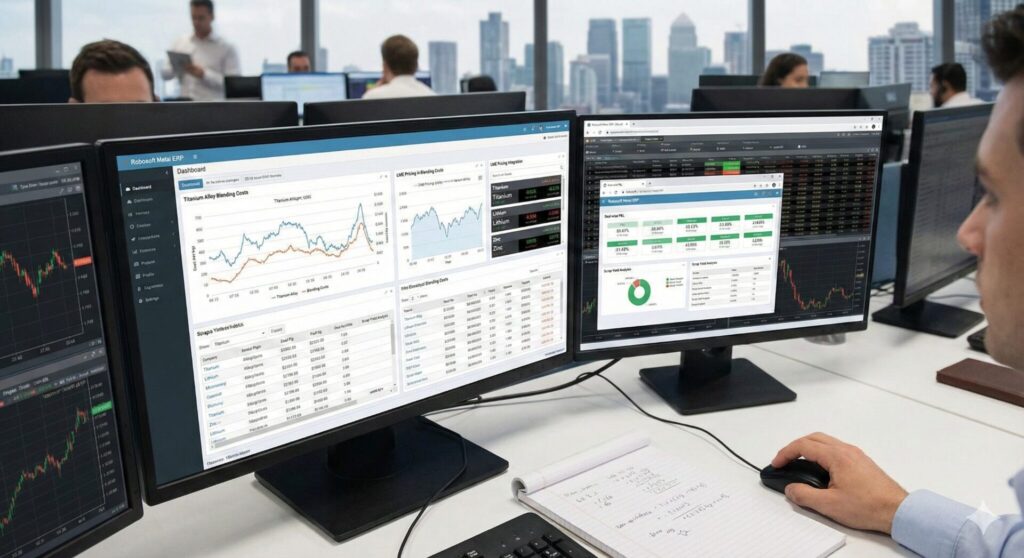
The Hidden Cost of Using Generic ERPs in Commodity Trading for Metals
The biggest failure of standard software is its inability to calculate the true cost of a deal in real-time.
In the non-ferrous sector, your profit is never just Sales Price – Purchase Price. It is a complex equation involving Processing and Yield.
The Real Formula for Profit:
(Stock Cost + Processing Cost) – Scrap Yield = True Profit/Loss
A standard ERP sees “Inventory.” It does not see “Scrap Yield.” It does not automatically calculate the blending cost of alloys. This means you often don’t know if a deal was profitable until weeks after it closes. By then, it is too late.
Titanium Trading: A League of Its Own
High-value metals like Titanium demand precision. Even a fraction of a percentage in purity variation changes the contract value entirely.
Standard systems force you to recalculate data because they cannot handle it manually:
- Automatic conversions from Kilograms to Metric Tonnes (MT).
- Tracking purity variations across different batches.
- Real-time analytics for base vs. battery metals.
Manual entry leads to errors. In commodity trading for metals, errors destroy margins.
The Difference Between “Tracking” Inventory and “Trading” It
Generic ERPs force you to work in silos. Robo-Commodity connects them.
We don’t just “store data.” We provide a unified backbone that links every stage of the trade:
- Trade Capture: We log volume, grade, purity, and counterparty immediately.
- Risk & Hedging: You can track shipments and hedge exposure instantly.
- Financials: We integrate seamlessly with LME and treasury systems, so your financing and settlement data is always live.
You get clarity, agility, and control. No more waiting for end-of-month reports.
Frequently Asked Questions (FAQ)
A standard ERP manages general finance and HR. Specialized software handles industry-specific needs like alloy blending, scrap yield analysis, and automatic unit conversions (kg to MT) without manual work.
Our system uses a specific logic: Stock Cost + Processing Cost – Scrap Yield. This guarantees that your scrap value is accounted for in your final profit calculation.
Yes. It handles automatic conversion from Kilograms (kg) to Metric Tonnes (MT), which is a requirement for high-value metals like Titanium.
Absolutely. We offer advanced risk and trade management tools that allow you to hedge exposure and monitor margin pressure instantly.
Yes. We have specific modules for “AI Powering Non-Ferrous & Lithium Edge,” giving you predictive intelligence for the battery metal market.
Stop Guessing Your Margins
The market is too volatile for “good enough” software. Get a clear picture of your profit/loss before you sell.
Request a Free Demo of Robo-Commodity
Author: Tracy